
Green Technology Metals (GT1:AU) has announced Successful A$4.5m Two Tranche Placement
Download the PDF here.
Green Technology Metals (GT1:AU) has announced Successful A$4.5m Two Tranche Placement
Download the PDF here.
Thousands of U.S.-bound packages shipped by UPS are trapped at hubs across the country, unable to clear the maze of new customs requirements imposed by the Trump administration.
As packages flagged for customs issues pile up in UPS warehouses, the company told NBC News it has begun “disposing of” some shipments.
Frustrated UPS customers describe waiting for weeks and trying to make sense of scores of conflicting tracking updates from the world’s largest courier.
“I’ve never seen anything like this before,” Matthew Wasserbach, brokerage manager of Express Customs Clearance, said of the UPS backlog. “It’s totally unprecedented.”
Wasserbach’s New York City-based shipping services firm helps clients move shipments through customs. He said the company has seen a spike in inquiries for help with UPS customs clearance.
More than two dozen people who are waiting for their UPS packages explained the circumstances of their shipments to NBC News.
They described shipments of tea, telescopes, luxury glassware, musical instruments and more — some worth tens of thousands of dollars — all in limbo or perhaps gone.
Others have deep sentimental value: notebooks, diplomas and even engagement rings.
The frustration has exploded online, with customers sharing horror stories on Reddit of missing skin care products, art and collectibles.
They are confused and angry, and they want answers.
“It’s almost impossible to get through to anybody to figure out what is happening,” said Ashley Freberg, who said she is missing several boxes she shipped via UPS from England in September.
“Are my packages actually being destroyed or not?”
Freberg’s boxes of journals, records and books were shipped on Sept. 18, according to tracking documents she shared with NBC News.
Over the next two weeks, she received two separate notifications from UPS that her personal mementos had not cleared customs and as a result had been “disposed of” by UPS.
Then, on Oct. 1, a UPS tracking update appeared for her packages, saying they were on the way. The tracking updates Freberg showed NBC News for that shipment revealed it was the most recent update she had received.
While sentimental value is impossible to measure, other customers fear they will not be able to recover financially if their goods were destroyed.
Tea importer Lauren Purvis of Portland, Oregon, said five shipments from Japan, mostly containing matcha green tea and collectively worth more than $127,000, were all sent via UPS over the last few weeks and arrived at UPS’ international package processing hub in Louisville, Kentucky. Purvis has yet to receive any of the shipments, only a flurry of conflicting tracking updates from UPS.
A series of notifications for one shipment, which she shared with NBC News, said that the shipment had not cleared customs and that UPS had disposed of it.
But a subsequent tracking update said the shipment had cleared customs and was on the way.
“We know how to properly document and pay for our packages,” Purvis said. “There should be zero reason that a properly documented and paid-for package would be set to be disposed of.”
At least a half-dozen people described an emotional seesaw they were put through by weeks of contradictory UPS tracking updates about their shipments. The updates, they said, compounded the stress of not knowing what had really happened to their possessions.
AJ, a Boston man who asked that NBC News use only his initials to protect his privacy, said he shipped a package from Japan via UPS on Sept. 12 including Japanese language books, a pillow and a backpack.
After it sat in Louisville for nearly two weeks, AJ got a tracking update on Sept. 26, one of several that he shared with NBC News. “We’re sorry, your package did not clear customs and has been removed from the UPS network. Per customs guidelines, it has been destroyed. Please contact the sender for more information,” it read.
Three days later, on Sept. 29, he received another, and this one read: “On the Way. Import Scan, Louisville, KY, United States.” For a moment, it appeared as though AJ’s shipment might have been found.
But less than 24 hours after his hopes were raised, another tracking update arrived: “We’re sorry,” it began. It was the same notice that his package had “been destroyed” that he had received on the 26th.
Two minutes later, he got his final update: “Unable to Deliver. Package cannot clear due to customs delay or missing info. Attempt to contact sender made. Package has been disposed of.”
International shipping was thrown into chaos after the long-standing “de minimis” tariff exemption for low-value packages ended on Aug. 29.
Packages with values of $800 or less, which were previously allowed to enter the United States duty-free, are now subject to a range of tariffs and fees.
They include hundreds of country-specific rates, or President Donald Trump’s so-called reciprocal tariffs, as well as new levies on certain products and materials.
The result is that international shipping to the United States today is far more complex and costly than it was even two months ago.
The sweeping changes have caught private individuals and veteran exporters alike in a customs conundrum.
It is difficult to know the exact number of the packages that are stuck in UPS customs purgatory. Shipping companies guard their delivery data closely.
UPS reported to investors that in 2023, its international service delivered around 3.2 million packages per day.
This week, the company told NBC News that it is clearing more than 90% of the packages it handles through customs on the first day.
The rest of the packages, or less than 10%, require more time to clear customs and need to be held until they do. That could easily mean that thousands of UPS packages every day are not clearing customs on their first try.
In a statement to NBC News, UPS said it is doing its best to get all packages to their destinations while abiding by the new customs requirements.
“Because of changes to U.S. import regulations, we are seeing many packages that are unable to clear customs due to missing or incomplete information about the shipment required for customs clearance,” it said.
UPS said it makes several attempts to get any missing information and clear delayed shipments, contacting shippers three times.
“In cases where we cannot obtain the necessary information to clear the package, there are two options,” it said.
“First, the package can be returned to the original shipper at their expense. Second, if the customer does not respond and the package cannot be cleared for delivery, disposing of the shipment is in compliance with U.S. customs regulations. We continue to work to bridge the gap of understanding tied to the new requirements and, as always, remain committed to serving our customers.”
NBC News asked UPS precisely what it does with packages when it tells customers their shipments have been unable to clear customs and have been “disposed of.” It would not say.
On Sept. 27, a shipper in Stockholm received a formal notification from UPS that two packages her glassware company sent to the United States — which failed to clear customs — would be destroyed.
“We are sorry, but due to these circumstances and the perishable nature of the contents, we are now required to proceed with destruction of the shipment in accordance with regulatory guidelines,” UPS told Anni Cernea in an email she shared with NBC News.
The email continued, “There is no need to contact our call center for further information or to attempt to clear this shipment.”
Cernea said, “It’s just outrageous that they can dispose of products like this without approval from either the sender or recipient.”
From now on, Cernea said, she plans to ship her products via UPS rival FedEx.
Cernea’s decision to switch carriers hints at the worst-case scenario for UPS, which is that people could abandon the company. It is a potential crisis for the roughly $70 billion company.
The company’s stock price is already down more than 30% this year, which analysts attribute to a mix of tariffs, competition and shifting shopping habits.
As she awaits her missing journals and diplomas from England, Freberg is looking ahead to the biggest shipping months of the year.
“I can’t even imagine how bad the holidays are going to be, because that’s a time where loads of people are shipping stuff overseas,” she said.
“If it doesn’t get solved soon, I can only see it becoming an even bigger issue.”
Isabella Morales contributed reporting.
Two years ago, I was kidnapped by Boko Haram. They held me captive, and every day I prayed that I would see my family again. By a miracle of God, I was able to escape.
Sadly, most Christians who are captured by this terrible organization never live to tell their stories. And unless the West intervenes, kidnappings like mine — as well as killings — will only increase in my country, spread across the African continent and threaten the rest of the world.
Today, as I travel throughout Nigeria providing relief as part of my work with iReach Global, I see that the violence has only grown—spreading like wildfire across the middle of my country, leaving behind a trail of ashes, mass graves and shattered lives.
This year has brought wave after wave of coordinated attacks in Central Nigeria. More than 7,000 Christians have been killed. Entire villages — most of them Christian farming communities — were razed. Families now live in makeshift camps, traumatized and uncertain if they’ll ever return home.
In early April, multiple coordinated assaults in the Bokkos area claimed hundreds of lives within a week. One community alone reported 52 deaths in a single attack, with thousands forced to flee.
Later that month, in an area called Bassa, at least 51 people were slaughtered in a pre-dawn raid. The attackers came silently, setting homes ablaze and killing entire families as they slept. In Riyom, ambushes and targeted killings continued for months afterward. In one case, a bus full of passengers was stopped and attacked — 12 people killed on the spot.
These are not random acts of violence. They are systematic, coordinated attempts to erase Christian communities from the region.
As someone who has walked through burned villages and prayed with survivors, I can tell you the reality is even worse than the statistics suggest. I’ve seen mothers weeping beside mass graves. The smell of smoke from the smoldering remains of churches and schools still clings to my clothes. I’ve also spoken with children who no longer sleep through the night because they fear the next attack will come for them.
This is not simply a matter of ‘clashes’ between farmers and herders, as government officials sometimes claim. It is a campaign of terror. It’s ethnic and religious cleansing disguised as conflict over land.
And yet, the Nigerian government continues to downplay the crisis — failing to provide protection, food or medical care to the displaced. Some local leaders even warn communities not to speak to the media. But silence will not save us.
I’ve seen mothers weeping beside mass graves. The smell of smoke from the smoldering remains of churches and schools still clings to my clothes.
The Nigerian government bears the primary responsibility to protect its people. That must begin with immediate and adequately resourced security deployments to protect vulnerable communities — especially during planting and harvest seasons when farmers are most exposed. Humanitarian corridors must be opened to deliver food and aid to thousands now living in desperate conditions.
Independent investigations are also essential. Impunity is the oxygen that fuels these killings. Perpetrators must be identified and prosecuted—no matter their political connections or tribal affiliations.
At the same time, Nigeria’s political class must stop turning our suffering into campaign slogans. I’ve heard politicians invoke the blood of victims as talking points during election campaigns while refusing to act. This must end. The lives of our people are not bargaining chips.
The United States and other Western nations cannot look away. They have both the moral obligation and the diplomatic tools to press Nigeria toward real accountability. I believe the U.S. State Department must reinstate Nigeria’s designation as a Country of Particular Concern for egregious violations of religious freedom. This would send a clear signal to my government that the world is watching, and the killing of Christians in Nigeria will not be ignored.
In addition, international partners should expand support for independent investigations and humanitarian assistance. I have visited many of these camps; the needs are immense. In some camps, families survive on one meal a day, drinking from muddy puddles, with no one to treat their wounds. Children go months without schooling. The international community can help fund the rebuilding of homes and provide psychosocial support for those who have endured unspeakable loss.
The victims of these attacks are not soldiers or combatants. They are farmers, families, children and elders. They want nothing more than to live in peace, tend their fields and worship freely. Yet they have become targets of a campaign of hate.
If urgent action is not taken, we risk watching entire Christian communities vanish from Nigeria’s Middle Belt. Not only that, but the reign of terror will continue to grow across the Sahel region of Africa and could ultimately threaten global security.
And the silence of the world will be remembered as complicity.
As someone who has survived the terror of Boko Haram and now witnesses this unfolding genocide, I plead with the global community: Do not look away. The suffering here is real, and it is growing.
Nigeria is bleeding. But it does not have to be this way. With courage and help from the international community, we can still stop the slaughter and begin the long work of rebuilding.
White House Deputy Chief of Staff Dan Scavino is poised to play an even larger role in President Donald Trump’s administration, the president announced Sunday.
Trump says Scavino, in addition to his current role, will now lead the White House Presidential Personnel Office. The office was previously held by Sergio Gor, who is now transitioning to become the U.S. Ambassador to India.
‘I am pleased to announce that the great Dan Scavino, in addition to remaining Deputy Chief of Staff of the Trump Administration, will head the White House Presidential Personnel Office, replacing Sergio Gor, who did a wonderful job in that position, and will now become the Ambassador to India,’ Trump wrote on Truth Social.
‘Dan will be responsible for the selection and appointment of almost all positions in government, a very big and important position. Congratulations Dan, you will do a fantastic job!’ he added.
Scavino’s new appointment comes as the Trump administration is in a pitched fight with Democrats to define the cause of the ongoing government shutdown.
Trump allies have pointed to Senate Minority Leader Chuck Schumer’s refusal to work with Republicans.
The president also sought to mitigate damage on Saturday by ordering War Secretary Pete Hegseth to make sure military service members get paid next week, regardless of the shutdown.
‘Chuck Schumer recently said, ‘Every day gets better’ during their Radical Left Shutdown,’ Trump wrote on Truth Social. ‘I DISAGREE! If nothing is done, because of ‘Leader’ Chuck Schumer and the Democrats, our Brave Troops will miss the paychecks they are rightfully due on October 15th.’
He said he directed Hegseth ‘to use all available funds to get our Troops PAID on October 15th. We have identified funds to do this, and Secretary Hegseth will use them to PAY OUR TROOPS.’
The government shut down on Oct. 1, after Democrats and Republicans failed to pass a spending bill to fund the government, with Democrats concerned expiring Affordable Care Act tax cuts could raise premiums and that Medicaid cuts could leave people without coverage.
Fox News’ Brie Stimson contributed to this report
President Donald Trump is in ‘excellent overall health,’ the president’s doctor said in a memorandum after a follow-up evaluation at Walter Reed National Military Medical Center on Friday.
Earlier this week, the White House announced that Trump, 79, would undergo a ‘routine’ semiannual physical on Friday.
The president also met with troops while at the hospital in Bethesda, Maryland.
‘President Donald J. Trump successfully completed a scheduled follow-up evaluation at Walter Reed National Military Medical Center,’ Navy Capt. Sean P. Barbabella, the physician to the president, wrote in a memorandum to White House press secretary Karoline Leavitt.
Barbabella said that the visit was part of an ongoing health maintenance plan that included ‘advanced imaging, laboratory testing and preventative health assessments conducted by multidisciplinary team of specialists.’
He added, ‘Comprehensive laboratory studies performed in conjunction with the visit were exceptional, including stable metabolic, hematologic and cardiac parameters.’
In his summary, Barbabella said Trump, ‘remains in exceptional health, exhibiting strong cardiovascular, pulmonary, neurological, and physical performance.’
Barbabella also said Trump also received updated COVID-19 and flu shots in preparation for international travel.
‘President Trump continues to demonstrate excellent overall health,’ he wrote, adding that his cardiac age was found to be ‘approximately 14 years younger than his chronological age. He continues to maintain a demanding daily schedule without restriction.’
The medical checkup will be Trump’s second this year. He had a similar exam in April, during which his physician stated that he ‘remains in excellent health.’
In July, the president was diagnosed with a vein condition known as chronic venous insufficiency. At the time, Leavitt said Trump had noticed ‘mild swelling’ in his lower legs and was evaluated by the White House medical unit.
Chronic venous insufficiency occurs when veins in the legs struggle to allow blood to flow back up to the heart.
Leavitt attributed the bruising on the president’s hand to ‘frequent handshaking and the use of aspirin.’
The government shutdown is poised to enter a third week, and Democrats still appear to be struggling in the search for a cohesive messaging strategy.
Senate Minority Leader Chuck Schumer, D-N.Y., received a barrage of GOP-led attacks on Thursday after he told Punchbowl News, ‘Every day gets better for us’ in reference to the shutdown dragging on.
Meanwhile, House Democrats’ group selfie taken on Sept. 29, just before the shutdown, received criticism from both sides of the aisle. Former Rep. Adam Kinzinger, R-Ill., who’s become a fierce critic of the GOP since leaving office, wrote on X, ‘These selfie things need to stop guys. Honestly, the democrats were great at social media but social media moved on from them. The kitschy, goofy ‘choose your fighter’ type stuff needs to stop.’
Democrats have been fighting to center the discussion on healthcare, and their argument that any deal to reopen the federal government must at least include an extension of COVID-19 pandemic-era enhanced Obamacare subsidies that are set to expire at the end of this year.
And while polls show that Americans overwhelmingly do support extending the subsidies, surveys taken of the government shutdown have been more mixed, with a significant number of Americans blaming both parties.
A new Reuters/Ipsos poll released on Wednesday showed 67% of Americans believe Republicans deserve ‘a fair amount or a great deal of blame’ for the shutdown, compared to 63% for Democrats.
A New York Times/Siena poll taken on the eve of the shutdown showed that Democrats had a similarly thin edge over the GOP in the shutdown fight, but that 65% of people did not believe Democrats should shut down the government if their demands were not met.
‘Democrats keep choosing the wrong fights, including the shutdown fight. At best, the shutdown will give them a political draw where the public will blame both parties,’ Julian Epstein, a former Democratic staffer for the House Judiciary Committee, told Fox News Digital.
‘But they will not get a game change out of this conflict, and the risk for them is the longer it goes on, the public will see it’s the Democrats who are narcissistically voting to shut down the government after losing the election.’
During an appearance on ‘Real Time With Bill Maher’ earlier this month, CNN political commentator and former Obama administration appointee Van Jones said Democrats ‘do the wrong thing at the wrong time for the right reason.’
Jones said he was in favor of extending the Obamacare subsidies but argued that it may have been folly for his party to pick that fight over the shutdown before people even got notice of their premiums potentially rising.
‘I get it, the base is upset … ’Please do something, do anything,’ but the ‘something’ probably shouldn’t be throwing a bunch of people out of work in the federal government and crushing the American government’s ability to function right before the pain was about to start,’ he said.
And it’s not yet clear if Democrats have an agreed-upon roadmap for how to navigate the shutdown yet.
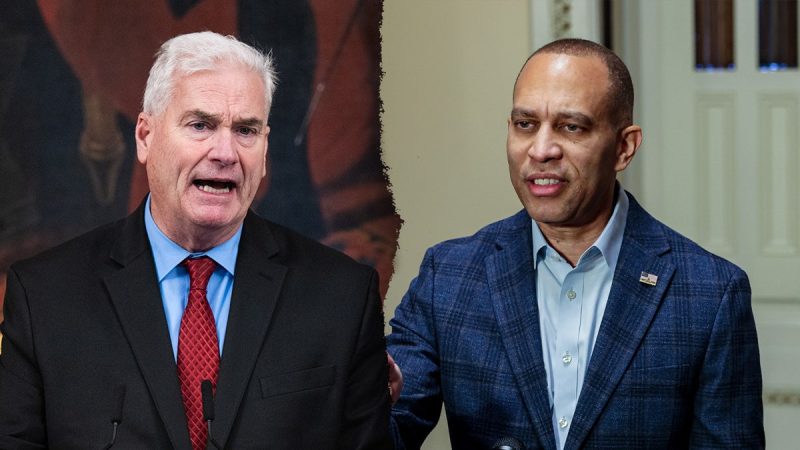
Late last week, just before Speaker Mike Johnson, R-La., announced that the House would be out of session for another week while Republicans’ funding bill stalled in the Senate, House Minority Leader Hakeem Jeffries, D-N.Y., unequivocally told Fox News Digital that ‘yes,’ he would call all House Democrats back to Washington to draw a contrast between the two sides.
He walked that back somewhat on Monday, however. When asked by Fox News Digital if he would still call the full caucus back, Jeffries said, ‘We have a caucus meeting at 6 p.m. today. We’ll have a House Democratic Caucus leadership meeting, that’s the full leadership, tomorrow. And I expect a strong presence of House Democrats throughout here in Washington.’
What he did not specify, however, was that the 6 p.m. caucus meeting was virtual.
At another press conference this week, Jeffries called a one-year Obamacare subsidy extension compromise bill ‘laughable’ despite it getting support from 11 members of his own Democratic caucus.
He walked those comments back again, ‘If anything is presented to us, of course, the caucus will consider it in good faith.’
But Republicans have also garnered their share of public criticism for shutdown messaging as well.
President Donald Trump’s aggressive rhetoric on federal employee layoffs put congressional Republicans in a difficult position earlier this month, though Trump has since softened his language and not yet carried out those firings.
The White House’s depiction of Jeffries in a sombrero on multiple occasions has also been panned as racist by critics.
Mike Nellis, a Democratic strategist and founder of campaign consulting firm Authentic, said Democrats were doing the right thing in focusing on health care while criticizing Republicans’ messaging.
‘I think that focusing on the health care subsidies, which are undeniably popular, has been a really smart thing for Democrats to do,’ Nellis told Fox News Digital.
‘I think that the Republicans have played right into their worst tendencies on this, which is, much of their messaging is aggressively online-focused. The sombrero stuff is mildly funny. But then they went all in on it, and they don’t have a good answer to the health care subsidies.’
Nellis also argued that Republicans’ touting of a ‘landslide’ electoral victory has set them up for a larger share of the blame.
‘When you create the conditions where you talked about the mandate that you have and the government shuts down on your watch, you’re responsible for the government shutdown,’ he said.
Still, he said he would grade Democrats with a ‘B, B minus’ on their messaging, adding that it’s ‘not perfect.’
‘Maybe the answer is … Republicans are losing the shutdown fight, rather than Democrats are winning it,’ Nellis said. ‘But I mean, I just think we’ve got a lot more right than a lot more wrong, which is the first time you can say that in quite a while.’
Statistics Canada released September’s job data on Friday (October 10). According to the release, 60,000 jobs were added to the Canadian economy during the month, and the employment rate increased to 60.6 percent, up 0.1 percent from August. However, the unemployment rate remained unchanged at 7.1 percent.
The increase in the labor market follows a significant decline of 106,000 combined jobs over the previous two months.
Leading the gains was the manufacturing sector, which added 28,000 jobs to the labor force. The increase was followed by 14,000 new workers in the health care and social assistance sector, and 13,000 new roles in the agriculture sector.
The natural resources sector posted a 2.2 percent gain, adding 7,100 new jobs over August’s numbers, but the sector shed 18,200 workers over September 2024.
Earlier in the week, StatsCan released a report on the economic contribution of critical mineral production in 2023 on Monday (October 6).
In 2023, critical mineral production contributed C$30.2 billion in nominal gross domestic product (GDP) and C$20.9 billion in real GDP terms, which accounted for 1.1 percent of the total economy and 37.4 percent of the mineral and mining sector.
The report also details a nominal GDP increase of 63 percent and a real GDP growth of 12.7 percent between 2019 and 2023. During the same period, job growth increased by 6.2 percent, with the subsector employing nearly 55,000 workers, outpacing the entire mineral and mining sector and the broader economy, which grew by 5.2 percent and 5.6 percent, respectively.
South of the border, the White House announced on Monday that President Donald Trump approved the Ambler Access Road project in Alaska. This was followed by a 50 to 46 vote by the Senate on Thursday evening to repeal a land management plan for Alaska that had delayed development of the road.
The controversial project would connect the Dalton Highway to the Ambler Mining District via a route that passed through the Gates of the Arctic National Park, considered one of the United States’ best-preserved parks.
The access road was initially approved during Trump’s first term in office, but approvals were rescinded in 2024 under the Biden administration due to the impact on the Western Arctic caribou herd, salmon and other wildlife. The Native American Tribes who live, hunt and fish in the area have largely stood in opposition to the road.
Proponents point to access to critical minerals like copper and gallium, which have become a focal point as the US seeks to increase domestic production of these minerals, which are required for the advancement of AI technologies, data centers and national defense.
Both gold and silver soared to record highs this week, with the gold price reaching US$4,058.98 per ounce on Wednesday (October 8) and the silver price climbing to an intraday all-time high of US$51.14 per ounce on Thursday (October 9). While gold has been consistently setting new records in 2025, silver broke its all-time high set in 1980.
Precious metals have seen broad gains since the start of the year, fueled by widespread uncertainty in the global economy due to factors including chaotic US trade policy and, most recently, the failure of US lawmakers to agree on a funding package to prevent the federal government from shutting down.
For more on what’s moving markets this week, check out our top market news round-up.
Canadian equity markets were mixed this week.
The S&P/TSX Composite Index (INDEXTSI:OSPTX) halted its record-breaking run this week, losing 1.17 percent to close Friday at 29,850.89.
The S&P/TSX Venture Composite Index (INDEXTSI:JX) fared better, ending a volatile week up 1.75 percent at 980.77. The CSE Composite Index (CSE:CSECOMP) was up 2.2 percent to close out the week at 184.31.
The gold price set another new record, reaching an intraday high of US$4,058.98 per ounce on Wednesday. On the week, gold was up 3.39 percent to US$4,018.68 by Friday’s close.
The silver price saw even stronger gains, breaking its own all time high on Thursday at US$51.14 per ounce, before pulling back slightly to post a weekly gain of 4.27 percent to US$50.03 per ounce by 4:00 p.m. EDT Friday.
Copper was up as much as 3 percent on the week during trading Thursday, but the copper price collapsed on Friday, falling from US$5.10 to end the week at US$4.80 per pound.
The S&P Goldman Sachs Commodities Index (INDEXSP:SPGSCI) fell 0.71 percent to end Friday at 539.97.
How did mining stocks perform against this backdrop?
Take a look at this week’s five best-performing Canadian mining stocks below.
Stocks data for this article was retrieved at 4:00 p.m. EDT on Friday using TradingView’s stock screener. Only companies trading on the TSX, TSXV and CSE with market caps greater than C$10 million are included. Mineral companies within the non-energy minerals, energy minerals, process industry and producer manufacturing sectors were considered.
Weekly gain: 282.35 percent
Market cap: C$44.59 million
Share price: C$0.65
Valhalla Metals is a polymetallic exploration company with a pair of projects in Alaska’s Ambler Mining District, the Sun and Smucker projects.
Its primary focus, the Sun project consists of 392 claims that cover an area of 25,382 hectares.
A May 2022 technical report states that the indicated resource for the project is 1.71 million metric tons of ore containing 55.85 million pounds of copper, 162.96 million pounds of zinc, 42.04 million pounds of lead, 3.3 million ounces of silver and 12,000 ounces of gold.
It also reported an inferred resource of 9.02 million metric tons containing 239.64 million pounds of copper, 831.33 million pounds of zinc, 290.26 million pounds of lead, 23.68 million ounces of silver and 73,000 ounces of gold.
The project is largely dependent on the construction of the 211 mile Ambler Access Road, which Trump approved in his first term. Former President Joe Biden rescinded the federal permit in 2024 due to environmental concerns, which is discussed in-depth above.
Shares in Valhalla surged this week after the Senate and the White House signaled support for the project. The company said in a news release on Tuesday (October 7) that it was excited by the reversal and will now be able to restart exploration and expand the known resources at the Sun Deposit.
Weekly gain: 191.35 percent
Market cap: C$1.53 billion
Share price: C$8.42
Trilogy Metals is a polymetallic exploration and development company working to advance its Upper Kobuk mineral projects in Northern Alaska, which it owns in a 50/50 joint venture with South32 (ASX:S32,OTC Pink:SHTLF).
Its most advanced asset is the Arctic copper, zinc, lead, gold and silver project, which is in the feasibility stage. In an updated feasibility study from February 2023, the company reported annual payable production volumes of 148.68 million pounds of copper, 172.6 million pounds of zinc, 25.75 million pounds of lead, 32,538 ounces of gold and 2.77 million ounces of silver.
After tax, the study pegged the net present value at US$1.11 billion, with an internal rate of return of 22.8 percent and a payback period of 3.1 years.
Trilogy’s other key asset is the Bornite copper-cobalt project located 25 kilometers southwest of its Arctic project. The site hosts widespread mineralization and has seen historic exploration dating back to the 1950s.
A preliminary economic assessment for Bornite, dated January 15, established an after-tax net present value of US$393.9 million, with an internal rate of return of 20 percent and a payback period of 4.4 years. The updated mineral resource included with the report estimates an inferred resource of 6.53 billion pounds of copper with an average grade of 1.42 percent from 208.9 million metric tons of ore.
Like Valhalla’s, shares in Trilogy surged this week on the news that the US government approved construction of the Ambler Access Road.
Additionally, Trilogy reported on Monday that it had entered into a binding letter of intent, that would see the US Department of Defense invest US$17.8 million in Trilogy in exchange for 8.22 million shares, or 10 percent of the company, and will hold warrants for an additional 7.5 percent.
Both Trilogy and the DoD stated that they will work in good faith to facilitate financing for the construction of the road and will include permit applications for the FAST-41 process to expedite mining development.
Weekly gain: 180.65 percent
Market cap: C$184.54 million
Share price: C$0.87
Ares Strategic Mining is a development company advancing its Lost Sheep fluorspar mine in Utah, US, to production.
Initially acquired in 2020, the property consists of 353 claims across 5,982 acres south-west of Salt Lake City. The Lost Sheep fluorspar mine is currently in the construction phase and has received backing from the state of Utah and the federal government. It is the only permitted fluorspar mine in the country.
Ares reported on July 31 that it had launched a program with Iowa State University and the Ames National Laboratory to explore the potential of extracting gallium from the site in addition to fluorspar,
As part of this research, the company indicated on September 16 that it had also confirmed the presence of germanium within fluorspar samples from its Lost Sheep mine. The company said that the discovery has the potential to unlock additional critical mineral value from the project.
In its most recent construction update on September 11, Ares reported the Lumps plant has reached an advanced stage, with concrete foundations and pads being completed and steel frame structures being erected.
Weekly gain: 154.55 percent
Market cap: C$17.04 billion
Share price: C$0.42
Nord Precious Metals is focused on advancing its projects in Ontario, Canada, and owns the TTL silver gravity plant in the region.
The company’s primary exploration property is the Castle project located south of Timmins in the Cobalt Camp. It covers an area of 7,332.76 hectares and hosts the past producing Castle mine complex, which produced 9.4 million ounces of silver and 376,000 pounds of cobalt.
A 2021 mineral resource estimate revealed a total inferred silver equivalent resource of 7.57 million ounces, with an average grade of 7,149 grams per metric ton (g/t) silver, 2,537 g/t cobalt, 628 g/t of copper, and 467 g/t of nickel, from 32.9 million metric tons of ore.
The company also owns the past-producing Beaver Mine, located just east of Castle along the border between Ontario and Quebec. The mine operated until 1940 and produced 7.1 million ounces of silver.
The company has been working on the development of a tailings recovery program at the site, announcing on October 1 that test work produced commercial high-grade silver with concentrations up to 2,114.9 g/t.
Nord is planning to apply for a recovery permit to process tailings at its TTL gravity plant, which it plans to begin commissioning once it receives the permit.
The company said that the results validate the technical approach to the tailings program.
Weekly gain: 145.45 percent
Market cap: C$47.82 billion
Share price: C$0.135
Avalon Advanced Materials is an explorer and developer focused on lithium projects in Canada.
The company’s flagship project is its 40 percent owned Separation Rapids lithium project in Ontario, a joint venture with SCR-Sibelco, which owns the remaining 60 percent.
The project consists of three primary lithium targets: the Separation Rapids deposit; the Snowbank target, located near Kenora; and the Lilypad project near Fort Hope, which also hosts tantalum and cesium mineralization.
The pair increased the project’s measured and indicated resource by 28 percent in late February.
Avalon is also developing the Lake Superior lithium processing facility in Thunder Bay, Ontario.
The most recent news from Avalon came on Thursday when it reported that it had produced lithium hydroxide and analcime using an alkaline leach process developed by Finnish mineral processing company Metso.
The company said that early assessments indicate a 60 percent potential reduction in water use, along with a smaller carbon footprint compared to traditional methods. It stated that the achievement marked a milestone for the company to establish a sustainable lithium processing solution at its facility
The TSX, or Toronto Stock Exchange, is used by senior companies with larger market caps, and the TSXV, or TSX Venture Exchange, is used by smaller-cap companies. Companies listed on the TSXV can graduate to the senior exchange.
As of May 2025, there were 1,565 companies listed on the TSXV, 910 of which were mining companies. Comparatively, the TSX was home to 1,899 companies, with 181 of those being mining companies.
Together, the TSX and TSXV host around 40 percent of the world’s public mining companies.
There are a variety of different fees that companies must pay to list on the TSXV, and according to the exchange, they can vary based on the transaction’s nature and complexity. The listing fee alone will most likely cost between C$10,000 to C$70,000. Accounting and auditing fees could rack up between C$25,000 and C$100,000, while legal fees are expected to be over C$75,000 and an underwriters’ commission may hit up to 12 percent.
The exchange lists a handful of other fees and expenses companies can expect, including but not limited to security commission and transfer agency fees, investor relations costs and director and officer liability insurance.
These are all just for the initial listing, of course. There are ongoing expenses once companies are trading, such as sustaining fees and additional listing fees, plus the costs associated with filing regular reports.
Investors can trade on the TSXV the way they would trade stocks on any exchange. This means they can use a stock broker or an individual investment account to buy and sell shares of TSXV-listed companies during the exchange’s trading hours.
Article by Dean Belder; FAQs by Lauren Kelly.
Securities Disclosure: I, Dean Belder, hold no direct investment interest in any company mentioned in this article.
Securities Disclosure: I, Lauren Kelly, hold no direct investment interest in any company mentioned in this article.
NOT FOR DISTRIBUTION TO U.S. NEWS WIRE SERVICES OR FOR DISSMINATION IN THE UNITED STATES.
Saga Metals Corp. (‘SAGA’ or the ‘Company’) (TSXV: SAGA,OTC:SAGMF) (OTCQB: SAGMF) (FSE: 20H), a North American exploration company focused on critical minerals, is pleased to announce the closing of its previously announced non-brokered private placement pursuant to which the Company raised aggregate gross proceeds of C$2,988,024.64 (the ‘ Offering ‘).
Pursuant to the Offering, the Company issued (i) 7,100,088 flow-through common share units of the Company (the ‘ FT Units ‘) at C$0.28 per FT Unit for gross proceeds of C$1,988,024.64, and (ii) 4,000,000 hard dollar common share units of the Company (the ‘ HD Units ‘, and together with the FT Units, the ‘ Securities ‘) at C$0.25 per HD Unit for gross proceeds of C$1,000,000.
Financing Overview:
Each FT Unit consists of one flow-through common share as defined in subsection 66(15) of the Income Tax Act (Canada) (the ‘ Tax Act ‘), and one-half of one transferable common share purchase warrant (each whole warrant, a ‘ Warrant ‘). Each Warrant will entitle its holder to purchase one common share in the capital of the Company (a ‘ Warrant Share ‘) at a price of C$0.50 until October 10, 2027. The Warrant Shares underlying the FT Units will not qualify as ‘flow-through shares’ under the Tax Act.
Each HD Unit consists of one common share and one-half of one Warrant. Each whole Warrant will entitle its holder to purchase one Warrant Share at a price of C$0.50 until October 10, 2027.
Each of the Warrants will be subject to the right of the Company to accelerate the expiry date of the Warrants to a date that is 30 days following dissemination of a news release announcing such acceleration if, at any time, after October 10, 2025 (the ‘ Closing Date ‘), the closing price of the Company’s common shares equals or exceeds C$0.75 for a period of ten consecutive trading days on the TSX Venture Exchange (the ‘ Exchange ‘).
All securities issued in connection with the Offering are subject to a hold period of four months and one day following the Closing Date pursuant to applicable securities laws, expiring February 11, 2026.
The Company paid cash finder’s fees in the aggregate amount of $130,003 and issued an aggregate of 478,204 finder’s warrants in connection with the Offering. Each finder’s warrant entitles the holder thereof to purchase one common share of the Company at a price of $0.50 per share for a period of 24 months from the Closing Date.
The gross proceeds from the FT Units will be used by the Company for ‘Canadian exploration expenses’ that are ‘flow-through critical mineral mining expenditures’ (as such terms are defined in the Tax Act) on the Company’s Canadian mineral resource properties. The net proceeds of the HD Units will be used by the Company for administrative and general working capital, which may include investor relations activities.
The securities of SAGA have not been and will not be registered under the United States Securities Act of 1933, as amended (the ‘ U.S. Securities Act ‘), or any state securities laws, and may not be offered or sold, within the United States, unless exemptions from the registration requirements of the U.S. Securities Act and applicable state securities laws are available.
No securities regulatory authority has reviewed or approved of the contents of this news release. This news release does not constitute an offer to sell or a solicitation of an offer to buy any securities of SAGA in any jurisdiction in which such offer, solicitation or sale would be unlawful.
Marketing Services Agreement with Capitaliz.
The Company further reports that it has entered into a digital marketing services agreement effective as of October 13, 2025 (the ‘ Capitaliz Agreement ‘) with 1123963 B.C. Ltd. D.B.A. Capitaliz (‘ Capitaliz ‘). Pursuant to the Capitaliz Agreement, Capitaliz will, among other things, provide the Company with certain marketing services to expand investor awareness of the Company’s business and to communicate with the investment community (the ‘ Capitaliz Services ‘). The Capitaliz Services will be provided by Capitaliz over a three-month term. The Capitaliz Agreement may be terminated at any time by either party with 30 days’ notice.
Capitaliz is a content-driven digital marketing agency that connects public companies with social media influencers across all major social media platforms, leveraging a creator network that reaches over 100 million subscribers.
The Capitaliz Services will include, among other things: (i) multimedia content creation and syndication, including the production and distribution of editorial video content; (ii) targeted traffic generation through a combination of pay-per-click advertising, social media marketing, native advertising, search engine optimization, email campaigns, and retargeting strategies; and (iii) strategic social media amplification of campaign content across platforms such as Investorhub and YouTube; and (iv) expanded distribution through established relationships with financial media platforms. In consideration of the Capitaliz Services, and pursuant to the terms and conditions of the Capitaliz Agreement, the Company has agreed to pay Capitaliz a fee of C$200,000 (plus applicable taxes) over a three-month term, which will be paid using the Company’s available working capital.
The Capitaliz Services will be rendered primarily online through a variety of news and investment community communications channels. Jeff Leslie, the principal of Capitaliz – located at 704 – 595 Howe Street, Box 35, Vancouver, BC, V6C 2T5 – will be involved in conducting the Capitaliz Services. Capitaliz and Mr. Leslie do not have any interest, directly or indirectly, in the Company or its securities, or any right or intent to acquire such an interest. The terms and conditions of the Capitaliz Agreement remain subject to approval of the Exchange.
Online Marketing Agreement with i2i Marketing Group, LLC.
In addition, the Company reports that it entered into an online marketing agreement (the ‘ i2i Agreement ‘) with i2i Marketing Group, LLC (‘ i2i ‘). Pursuant to the i2i Agreement, i2i will, among other things, provide the Company with corporate marketing and investor awareness services, including, but not limited to, content creation management, author sourcing, project management and media distribution (the ‘ i2i Services ‘). The i2i Services will be provided by i2i pursuant to an initial US$250,000 budget, which will be paid using the Company’s available working capital, and may continue on a month-to-month basis thereafter until the i2i Agreement is terminated. The i2i Agreement may be terminated by either party upon 10 days’ advance written notice to the other party during the contract term.
The i2i Services will be rendered primarily online through a variety of news and investment community communications channels. Joe Grubb and Kailyn White, principals of i2i will be providing services on behalf of i2i, which has an office located at 1107 Key Plaza #222 Key West, FL 33040. i2i, Mr. Grubb, and Ms. White do not have any interest, directly or indirectly, in the Company or its securities, or any right or intent to acquire such an interest.
The terms and conditions of the i2i Agreement remain subject to approval of the Exchange.
About Saga Metals Corp.
Saga Metals Corp. is a North American mining company focused on the exploration and discovery of a diversified suite of critical minerals that support the global transition to green energy. The Radar Titanium Project comprises 24,175 hectares and entirely encloses the Dykes River intrusive complex, mapped at 160 km² on the surface near Cartwright, Labrador. Exploration to date, including a 2,200m drill program, has confirmed a large and mineralized layered mafic intrusion hosting vanadiferous titanomagnetite (VTM) with strong grades of titanium and vanadium.
The Double Mer Uranium Project, also in Labrador, covers 25,600 hectares featuring uranium radiometrics that highlight an 18km east-west trend, with a confirmed 14km section producing samples as high as 0.428% U 3 O 8 and uranium uranophane was identified in several areas of highest radiometric response (2024 Double Mer Technical Report).
Additionally, SAGA owns the Legacy Lithium Property in Quebec’s Eeyou Istchee James Bay region. This project, developed in partnership with Rio Tinto, has been expanded through the acquisition of the Amirault Lithium Project. Together, these properties cover 65,849 hectares and share significant geological continuity with other major players in the area, including Rio Tinto, Winsome Resources, Azimut Exploration, and Loyal Metals.
With a portfolio that spans key minerals crucial to the green energy transition, SAGA is strategically positioned to play an essential role in the clean energy future.
On Behalf of the Board of Directors
Mike Stier, Chief Executive Officer
For more information, contact:
Rob Guzman, Investor Relations
Saga Metals Corp.
Tel: +1 (844) 724-2638
Email: rob@sagametals.com
www.sagametals.com
Neither the TSX Venture Exchange nor its Regulation Service Provider (as that term is defined in the policies of the TSX Venture Exchange) accepts responsibility for the adequacy or accuracy of this release.
Cautionary Disclaimer
This news release contains forward-looking statements within the meaning of applicable securities laws that are not historical facts. Forward-looking statements are often identified by terms such as ‘will’, ‘may’, ‘should’, ‘anticipates’, ‘expects’, ‘believes’, and similar expressions or the negative of these words or other comparable terminology. All statements other than statements of historical fact, included in this release are forward-looking statements that involve risks and uncertainties. In particular, this news release contains forward-looking statements regarding discussions of future plans, estimates and forecasts and statements as to management’s expectations and intentions with respect to, among other things, the Offering, including the expected use of proceeds from the Offering, the receipt of the Capitaliz Services and the i2i Services, and the terms of the Capitaliz Agreement and the i2i Agreement. There can be no assurance that such statements will prove to be accurate and actual results and future events could differ materially from those anticipated in such statements. Important factors that could cause actual results to differ materially from the Company’s expectations include, but are not limited to, changes in the state of equity and debt markets, fluctuations in commodity prices, delays in obtaining required regulatory or governmental approvals, environmental risks, limitations on insurance coverage, inherent risks and uncertainties involved in the mineral exploration and development industry, particularly given the early-stage nature of the Company’s assets, and the risks detailed in the Company’s continuous disclosure filings with securities regulations from time to time, available under its SEDAR+ profile at www.sedarplus.ca. The reader is cautioned that assumptions used in the preparation of any forward-looking information may prove to be incorrect. Events or circumstances may cause actual results to differ materially from those predicted, as a result of numerous known and unknown risks, uncertainties, and other factors, many of which are beyond the control of the Company. The reader is cautioned not to place undue reliance on any forward-looking information. Such information, although considered reasonable by management at the time of preparation, may prove to be incorrect and actual results may differ materially from those anticipated. Forward-looking statements contained in this news release are expressly qualified by this cautionary statement. The forward-looking statements contained in this news release are made as of the date of this news release and the Company will update or revise publicly any of the included forward-looking statements only as expressly required by applicable law.
News Provided by GlobeNewswire via QuoteMedia
HONG KONG — China outlined new curbs on exports of rare earths and related technologies on Thursday, extending controls over use of the elements critical for many high-tech and military products ahead of a meeting in about three weeks between President Donald Trump and Chinese leader Xi Jinping.
The regulations announced by the Ministry of Commerce require foreign companies to get special approval to export items that contain even small traces of rare earths elements sourced from China. These critical minerals are needed in a broad range of products, from jet engines, radar systems and electric vehicles to consumer electronics including laptops and phones.
Beijing will also impose permitting requirements on exports of technologies related to rare earths mining, smelting, recycling and magnet-making, it said.
China accounts for nearly 70% of the world’s rare earths mining. It also controls roughly 90% of global rare earths processing. Access to such materials is a key point of contention in trade talks between Washington and Beijing.
As Trump has raised tariffs on imports of many products from China, Beijing has doubled down on controls on the strategically vital minerals, raising concerns over potential shortages for manufacturers in the U.S. and elsewhere.
It was not immediately clear how China plans to enforce the new policies overseas.
During a cabinet meeting Thursday, Trump said he had yet to be briefed on the new rules but suggested that the U.S. could stop buying Chinese goods. “We import from China massive amounts,” Trump said. “Maybe we’ll have to stop doing that.”
Neha Mukherjee, a rare earths analyst at Benchmark Mineral Intelligence, called the new export controls “a strategic move by China that mirror some of Washington’s new chip export rules.
“Most rare earth magnet manufacturers in the U.S., Japan and elsewhere remain heavily dependent on rare earths from China, so these restrictions will force some difficult decisions — especially for any company involved in military uses of rare earths because most of those export licenses are expected to be denied, he said.
“The message is clear: if the U.S. and its allies want supply chain security, they must build independent value chains from mine to magnet,” Mukherjee said.
The new restrictions are to “better safeguard national security” and to stop uses in “sensitive fields such as the military” that stem from rare earths processed or sourced from China or from its related technologies, the Commerce Ministry said.
It said some unnamed “overseas bodies and individuals” had transferred rare earths elements and technologies from China abroad for military or other sensitive uses which caused “significant damage” to its national security.
The new curbs were announced just weeks ahead of an expected meeting between Trump and Chinese President Xi Jinping on the sidelines of the Asia-Pacific Economic Cooperation forum in South Korea, that begins at the end of this month.
“Rare earths will continue to be a key part of negotiations for Washington and Beijing,” George Chen, a partner at The Asia Group, said in an emailed comment. “Both sides want more stability but there will be still a lot of noises before the two leaders, President Trump and Xi, can make a final deal next year when they meet. Those noises are all negotiation tactics.”
These new restrictions will likely prompt additional government and private investments in developing a mine-to-magnet supply chain outside of China. Mukherjee said that $520 million of investments in the American rare earths industry were announced just in the second quarter with most of that coming from the government.
And there is some progress already being made with American magnet maker Noveon announcing an agreement with Lynas Rare Earths this week to secure a supply of rare earths outside of China from Lynas’ mine in Australia, and MP Materials preparing to begin producing magnets later this year at its new plant in Texas that uses rare earths from the only U.S. mine that it operates in California.
In July, the U.S. Defense Department agreed to invest $400 million in shares of the Las Vegas company, establish a floor for the price of key elements, and ensure that all of the magnets made at a new plant in the first 10 years are purchased.
An MP Materials spokesperson said China’s action “reinforces the need for forward-leaning U.S. industrial policy. Building resilient supply chains is a matter of economic and national security.”
Wade Senti, president of the U.S. permanent magnet company AML, said it’s time to innovate.
“The game of chess that China is playing underscores the importance of developing innovation that changes the game and puts the United States in leading position,” Senti said.
Nazak Nikakhtar, a former Commerce Department undersecretary, said the new restrictions are “a significant development and escalation” by extending controls to related technology and equipment and to sectors like chipmakers. “This should be a wake-up call to the U.S. government that we need to invest in and appropriate more to domestic capabilities. Both are critical to rebuild America’s rare earths industrial base,” she said.
In April, Chinese authorities imposed export curbs on seven rare earth elements shortly after Trump unveiled his steep tariffs on many trading partners including China.
While supplies remain uncertain, China approved some permits for rare earth exports in June and said it was speeding up its approval processes.
Senate Republicans are taking a hands-off approach to threats from White House budget chief Russ Vought, arguing that his pressure on Senate Democrats to reopen the government, for now, is warranted.
Away from the gridlock on Capitol Hill, Vought, who is the director of the Office of Management and Budget (OMB), has made moves to pressure Senate Democrats, led by Senate Minority Leader Chuck Schumer, D-N.Y., to reopen the government.
Before the shutdown started earlier this month, the OMB released a memo to government agencies instructing mass firings beyond the typical furloughs of nonessential employees during government shutdowns. He has since withheld nearly $30 billion in infrastructure funding to blue states and cities.
And earlier this week, a memo circulated around the White House that suggested that furloughed employees would not receive back pay when the government reopened — a move that runs counter to a law signed by President Donald Trump in 2019.
‘We heard earlier, right at the beginning of the shutdown, that we may see some terminations, some firings within the department,’ Sen. Lisa Murkowski, R-Alaska, told Fox News Digital. ‘We saw a lot of big numbers kind of thrown around, and they haven’t materialized, which I think is good, but certainly what it does, it’s very unsettling.’
The administration’s latest actions come as conversations on a path out of the shutdown have been ongoing. For now, Republicans don’t believe that Vought’s moves are undercutting those talks.
Sen. John Hoeven. R-N.D., told Fox News Digital that Vought was what Vought ‘thinks probably helps push Democrats to come to the table and open the government back up.’
‘I mean, that’s for him to decide,’ he said. ‘What I’m looking to do is to try to talk to enough Democrats, and I hope that between reaching out to them and pressure they get from back home, we can get the government open and back to work on these things.’
Senate Majority Leader John Thune, R-S.D., told Fox News Digital that the administration was ‘going to do what they’re going to do, and they’ve got to manage this, and they’re going to manage it according to their priorities.’
‘I think they’re trying to be sensitive to discussions up here that might be productive,’ Thune said. ‘But, you know, as of right now, it’s like I said before, all this stuff is just kind of window dressing until we fundamentally get down to the issue about, are we going to open up the government or not?
‘And I think when all those issues go away, these guys, the things that the White House is talking about doing or hinting that they might do, become unnecessary,’ he continued.
Senate Democrats are demanding a deal extending expiring Obamacare subsidies, and won’t provide the votes needed to reopen the government unless they get more than a guarantee to tackle the issue.
Thune and Senate Republicans are adamant that they will negotiate on extending the tax credits, with reforms baked in, only after the government reopens. And so far, as the stalemate has dragged on, neither Vought nor the administration have taken action on their threats of mass firings or back pay.
‘Right now it’s fine,’ Sen. Thom Tillis, R-N.C., told Fox News Digital. ‘If he starts taking Draconian sorts of actions, then I think it creates a more difficult scenario for us. It puts us further away from what he wants to get accomplished, too.’
Still, Senate Democrats have not taken kindly to his overtures.
Sen. Gary Peters, D-Mich., told Fox News Digital that there was ‘no question’ Vought was hurting ongoing talks between the parties.
‘Russ Vought is basically acting like a bomb thrower, and bomb throwers are never helpful in negotiations,’ he said.