Rapid Critical Metals (RLL:AU) has announced RCM to Acquire Webbs Consol Silver Project from Lode Res.
Download the PDF here.
This post appeared first on investingnews.com


Rapid Critical Metals (RLL:AU) has announced RCM to Acquire Webbs Consol Silver Project from Lode Res.
Download the PDF here.
Basin Energy offers uranium and rare earth exposure through high conviction exploration projects within tier-1 jurisdictions.
The group’s primary focus is the testing of district scale uranium and rare earth potential at the Sybella Barkly project, located directly west of the prolific mining town of Mount Isa, in northwest Queensland. These projects are deemed prospective for roll-front uranium, shear hosted hard rock uranium, sediment/ionic clay hosted rare earth elements and for hard rock rare earths. Evidence in support of this comes from the direct proximity and geological analogies to both ASX Paladin Energy’s Valhalla uranium deposit and its uranium source, the Sybella Batholith and for rare earth potential adjacent to ASX Red Metal’s Sybella Discovery.
The company also provides strategic exposure to three projects in Canada’s Athabasca Basin, the heartland of uranium exploration, where it is partnered with TSXV CanAlaska uranium and has a strategic early mover position in the emerging energy metals districts of Sweden and Finland ranked 6 and 1, respectively on the Fraser index in 2024.
With a technically driven exploration focus for uranium and rare earth minerals within tier-one jurisdictions, Basin Energy is well-positioned to capitalize on the global push for clean energy.
Basin holds 5,958 sq km of exploration tenure in the Mount Isa district of northwest Queensland. The projects provide compelling walk-up drill targets that can be rapidly and cost-effectively tested using air core and reverse circulation (RC) drilling.
The drill-ready, district scale opportunity includes:
In addition to these three district-scale targets, the project area contains multiple shear-hosted Valhalla-style uranium targets defined for immediate assessment.
Project location map
The primary model is based on mineralisation sourced from the various granites of the Sybella Batholith, a large north-south trending igneous body containing zones enriched in rare earth elements. This includes the Red Metal (ASX:RDM) giant Sybella Discovery. Several granites from the Sybella are also uranium rich, potentially being the source of Paladin Energy’s (ASX:PDN) Valhalla deposits.
The projects cover an extensive portion of the Sybella Batholith, deemed prospective for granite-hosted REEs, as well as a significant landholding west of the Sybella, known as the Barkly Tablelands. The Barkly Tablelands are regarded as prospective for sediment-hosted mineralisation and was surveyed with airborne electromagnetics (AEM) by Summit Resources in February 2007, prior to its acquisition by Paladin Energy. Whilst numerous targets were identified, no drilling was completed at the time. Importantly, past exploration focused mainly on base metals, phosphate and water bores, meaning the uranium and rare earth potential remains virtually untouched.
Prospective target concepts
The Summit Resources AEM survey identified an extensive network of paleochannels within the Barkly Tablelands, fed from the uranium-rich Sybella Batholith. This network trends south beyond the limits of existing survey data, suggesting even further potential remains to be identified.
Historical drilling in the area noted geological features typically associated with uranium deposits, such as redox fronts, sandstone channels and impermeable cap rocks. However, no uranium assays were conducted at the time.
Given the Sybella granites are considered the potential source of Paladin’s nearby Valhalla uranium deposits, Basin believes significant uranium will have also been transported into these paleochannels through erosion and chemical leaching processes. Previous work by Summit Resources and Furgo has already prioritised several high-potential targets. Basin plans to complete a first pass aircore drilling program to delineate this potential in Q4 2025.
Ternary radiometrics and AEM conductivity depth slice (paleochannels are projected to surface)
Surface and auger geochemistry sampling across the Barkly Tablelands has confirmed significant REE enrichment, with multiple results exceeding 600 ppm TREO. The sediments are directly sourced from the Sybella Batholith with the highest of these values located directly down drainage catchments linked to Red Metals Sybella Discovery.
Sediment-hosted REEs and target zones
Previous AEM surveys also revealed a broad conductive layer within the Barkly Tablelands sediments, approximately 12 metres thick at shallow depths between 20-32 metres, and covering a footprint of over 1,000 sq km. This layer is interpreted to represent a clay-rich unit capable of hosting ionic clay REE deposits.
AEM outlining laterally extensive conductive sediment target
The various granites that make up the Sybella contain zones of enriched REEs, including the Red Metal (ASX:RDM) owned Sybella Discovery.
Basin’s ground includes several prospects (Newsmans Bore, Eight Mile and Threeways) where a shallow proof of concept auger drilling program returned highly encouraging results in 2023.
The most encouraging results from the auger drilling at Newmans Bore reported at over 0.5 m at >1000 ppm TREO, including:
These results are very significant, as mineralisation continued to the end of hole and closely mirrors the geochemical patterns seen by Red Metal prior to their Sybella discovery.
Auger drilling completed by NeoDys, with highlights from Newmans Bore
Red Metals Discovery REE anomaly
Red Metal utilised RC drilling beneath this anomaly and identified broad zones of rare earth anomalism, which led to the Sybella discovery. NeoDys’ auger drilling across Basin’s project has outlined similar levels and scale of rare earth anomalism, demonstrating strong potential for comparable discoveries. See figure below.
Stylised section of NeoDys Newmans Bore auger drilling
The next phase for Basin will be to conduct deeper RC drilling to test potential continuity of these anomalies. Drilling is proposed for Q4 2025.
In addition to the three district scale targets, Basin also sees strong potential for Valhalla-style shear zone uranium mineralisation within the North section of the license. Airborne radiometric data highlights several anomalies crossing both the Sybella granite and the Cromwell metabasalt, features consistent with the alternation patterns seen at other uranium deposits in the region. The scale and geological setting of these radiometric anomalies draws comparison to Paladin Energy’s Mount Isa (Valhalla) project, which contains 148.4 Mlbs of U3O8 at 728 ppm, and a combined 116 Mlbs within the Valhalla, Odin and Skal resources located just 7 km east of Basin’s license
Filtered airborne radiometric data (isolating high-U, low-K rocks) highlighting several potential Valhalla-style shear zone targets in the Cromwell Metabasalt and the adjacent Sybella Batholith
Strategic Global Uranium Exposure
Basin holds interests in three projects, in partnership with TSX-V CanAlaska within the heartland of the world class Athabasca Basin uranium district. The company’s primary focus here is on the Geikie project where early drilling has identified a significant alteration system with analogies to major basement hosted uranium deposits of the district such as Nexgen energy’s prolific Arrow discovery. The company is actively seeking partnerships for the Marshall and North Millennium projects, which are prospective for unconformity style mineralisation with walk up drill ready targets.
The Geikie Project spans 351 sq km on the eastern margin of the Athabasca Basin and benefits from excellent access, with Highway 905 just 10 km to the east.
This underexplored region is considered highly prospective for shallow, basement-hosted uranium mineralisation. Historically overlooked in past exploration campaigns, the area has seen renewed interest following recent basement-style uranium discoveries elsewhere in the district.
In 2025, Basin Energy addedtwo new claims to the Geikie uranium project, consisting of 22.3 sq km, bringing the total project area to 373.1 sq km. Mineral claims MC00022218 and MC00022219 are contiguous to the Preston Creek prospect, where 2024 drilling outlined a large-scale hydrothermal system within a complex structural corridor with uranium anomalism.
Basin has secured 100 percent ownership of multiple reservations and licences across Sweden and Finland, prospective for uranium and critical green energy metals. This portfolio targets shear-hosted and intrusive-related mineralisation and consists of five exploration licenses within Sweden and five reservations in Finland. In 2025, Basin Energy announced theapproval for the Trollberget project application located in Northern Sweden, between the Björkberget and Rävaberget projects within the Arvidsjaur-Arjeplog uranium district. The project added 116 sq km of exploration land, increasing Basin Energy’s total holding to 219 sq km within this highly prospective uranium and green energy metals district.
These results reinforce the high-grade uranium potential of Basin’s Scandinavian portfolio and will directly guide the next phase of drill targeting.
Blake Steele is an experienced metals and mining industry executive and director with extensive knowledge across public companies and capital markets. He was formerly president and chief executive officer of Azarga Uranium (Azarga), a US-focused integrated uranium exploration and development company. He led Azarga into an advanced stage multi- asset business, which was ultimately acquired by enCore Energy (TSXV:EU) for C$200 million in February 2022.
Pete Moorhouse has 18 years of mining and exploration geology experience with extensive experience in the junior uranium sector, having spent over 10 years with ASX-listed uranium explorer and developer Alligator Energy (ASX:AGE). He holds significant competencies in evaluating, exploring, resource drilling and feasibility studies across many global uranium and resource projects.
Cory Belyk holds 30 years’ experience in exploration and mining operations, project evaluation, business development and extensive global uranium experience most recently employed by Cameco in the Athabasca Basin. He was a member of the exploration management team that discovered Fox Lake & West McArthur uranium deposits. Currently CEO/VP of Canadian Athabasca uranium explorer and project generator, CanAlaska (TSXV:CVV).
Matgthew O’Kane is an experienced executive and company director with over 25 years’ experience in the mining and mineral exploration, commodities, and automotive sectors. He has held senior leadership roles in Australia, Asia and North America, in both developed and emerging markets, from start-up companies through to multinational corporations. He has served on the Board of mining and mineral exploration companies in Canada, Hong Kong and Australia. He was a member of the Board of Azarga Uranium from 2013 until its sale to Encore Energy in February of 2022. He is currently a director of two ASX listed exploration and development companies.
Ben Donovan has over 22 years of experience in the provision of corporate advisory and company secretary services. He holds extensive experience in ASX listing rules compliance and corporate governance and has served as a Senior Adviser to the ASX for nearly 3 years Currently CoSec to several ASX listed resource companies including M3 Mining (ASX:M3M), Magnetic Resources (ASX:MAU) and Legacy Iron Ore (ASX:LCY).
Odile Maufrais is an exploration geologist with over 14 years of experience and has an extensive understanding of the uranium exploration and mining industry, having worked at ORANO, one of the largest global uranium producers, for 12 years on various assignments in Canada, Niger, and France. Maufrais has significant Athabasca Basin-specific experience, being involved in over 15 greenfield and brownfield uranium exploration projects located throughout the Basin. Her most recent roles for ORANO comprised leading various uranium exploration campaigns and being an active member of the ORANO research and development team, which involved working on trialing and implementing cost-effective and streamlined drilling techniques within the Athabasca Basin. She also played a key role in the update of the National Instrument 43-101 compliant mineral resource estimate for the Midwest Main and Midwest A deposits. Maufrais holds a Master of Science from Montpellier II University, France.

Dr. Sohan Dasgupta, appointed earlier this year as the political head of the Millennium Challenge Corporation (MCC), told Fox News Digital he is stepping down after a four-month sprint, declaring his mission to preserve and reposition the U.S. agency as a strategic foreign policy tool as ‘accomplished.’
Created by Congress in 2004, MCC delivers five-year infrastructure and energy compacts to developing nations that meet strict governance standards. Unlike traditional aid, its investments are structured to drive long-term economic growth and open markets for U.S. companies.
Since its creation under President George W. Bush, MCC has often been grouped with other U.S. aid programs.
Career staff have long emphasized development goals like poverty reduction, education, and infrastructure, but unlike USAID, MCC was established as a corporate body with a fiduciary duty to ensure effectiveness.
A White House official, speaking on background to Fox News Digital, argued the agency too often presented itself as aid rather than investment before President Donald Trump took office.
Dasgupta pushed staff to adopt a different lens, pressing them to evaluate projects based on the return on investment for the United States, the degree of strategic alignment with partner countries, and whether MCC compacts could be used to strengthen U.S. leverage in negotiations.
A Center for Strategic and International Studies (CSIS) report this spring argued that MCC is not a traditional aid agency but an ‘investment’ tool uniquely suited for an ‘America First’ agenda.
The authors warned shuttering it would hand China ‘diplomatic and economic wins’ while leaving half-built projects abroad, and noted Trump-era partner selections, from Nepal to Côte d’Ivoire to the Pacific Islands, were strategically chosen to counter Chinese influence.
‘The United States and the world are safer, stronger, and more prosperous with the MCC model than without it,’ the report concluded.
MCC’s current portfolio under Trump includes some of its largest-ever compacts: a $500 million deal in Nepal funding nearly 200 miles of transmission lines, a $480 million compact in Sierra Leone expanding electricity access and a $202 million program in Kosovo focused on grid-scale battery storage. Other investments include $536 million in Côte d’Ivoire, $537 million in Mozambique and a water compact in Mongolia.
Dasgupta told Fox News Digital that his role was to press MCC staff to think in terms of U.S. national security and economic benefits. ‘Reforming MCC into a vital national security and foreign policy asset’ was how he described his ‘mission accomplished’ moment.
A May 9 email from the White House Liaison to MCC staff, obtained by Fox News Digital, shows Dasgupta was appointed as a Schedule C Senior Advisor ‘assuming political leadership for the agency.’
MCC’s Fiscal Year 2026 Candidate Country Report, released this month, lists Kosovo, Nepal, Sierra Leone, Côte d’Ivoire, Mozambique, Mongolia, Solomon Islands, Fiji and Tonga among its eligible partner nations.
‘Service has many forms. My goal was to carry out particular projects and missions, then make way for others,’ Dasgupta said.
On China, he added: ‘Critical minerals and rare earth elements are a vital part of American strength … MCC has really understood that.’
Kosovo’s ambassador to the U.S., Ilir Dugolli, praised Dasgupta’s responsiveness. ‘We worked closely soon after he arrived at MCC … I respect him enormously for the way he handled his portfolio and how professional he was,’ Dugolli told Fox News Digital.
On energy security, Dugolli said: ‘Kosovo fully aligns with U.S. foreign policy … Batteries are extremely important, especially after last year’s terrorist attack on the Iber-Lepenc canal. The compact is the single most critical investment for our country’s energy security and economic resilience.’
Dasgupta’s departure also comes as the Trump administration pursues cuts to traditional U.S. foreign aid programs and seeks to reframe America’s global engagement under its ‘America First’ policy.
While agencies such as USAID have faced reductions and restructuring, Dasgupta argues the MCC has been preserved as a leaner, investment-driven tool aligned with the administration’s emphasis on strategic deals and competition with China.
Analysts estimate China controls about 70% of global rare earth mining and nearly 90% of processing capacity, according to the Oxford Institute for Energy Studies.
Between 2023 and 2025, China imposed export restrictions on strategic minerals, according to CSIS. Dasgupta argues MCC’s work in allied nations can help diversify supply chains and strengthen resilience, though MCC has not publicly described critical minerals as a formal focus of its work.
‘Quick wins’ like Kosovo’s battery project and Nepal’s power lines, Dasgupta said, show how American aid can advance prosperity abroad while reinforcing security at home.
With his departure, MCC continues compacts in dozens of countries worldwide.
The MCC did not immediately respond to Fox News Digital’s request for comment.

President Donald Trump has attacked the Senate for blocking his preferred nominees from being confirmed to key positions, but lawmakers and people familiar with the process say the Senate is not necessarily to blame.
Trump has faulted the Senate’s ‘blue slip’ tradition, an unwritten rule requiring nominees for judge, U.S. attorney and U.S. marshal to obtain home state senators’ approval prior to being confirmed.
He said blue state senators will only greenlight ‘Democrats or maybe weak Republicans.’ The president called on Sen. Chuck Grassley, R-Iowa, chairman of the Senate Judiciary Committee, to abolish the practice, and he threatened to sue over it.
But Grassley and other Republicans are unbudging in their position that blue slips are an indispensable part of the confirmation process. Blue slips have been used for more than a century. Past presidents have gotten many nominees confirmed under the system, suggesting other factors are contributing to Trump’s struggle to secure blue slips from Democrats.
Trump and his allies escalated attacks on the blue slip process this week, accusing Grassley of blocking nominees by maintaining it.
‘This is because of an old and outdated ‘custom’ known as a BLUE SLIP, that Senator Chuck Grassley, of the Great State of Iowa, refuses to overturn,’ Trump wrote on Truth Social.
The president threatened to sue over what he said was a ‘gentlemen’s agreement,’ though it is unclear whom the government would sue and on what grounds.
‘It’s not based on law, and I think it’s unconstitutional, and I’ll probably be filing a suit on that pretty soon,’ Trump told reporters in the Oval Office.
Asked about the possible lawsuit and why Trump’s nominees in blue states are struggling with confirmation, the White House told Fox News Digital in a statement the holdup must be addressed.
‘Senate Democrats have led a campaign of historic obstruction against President Trump and his nominees,’ White House spokeswoman Abigail Jackson said. ‘The left’s partisan, obstructionist agenda is only hurting the American people and it must end.’
Trump appointed his former personal defense lawyer Alina Habba as ‘interim’ U.S. attorney, which carries a 120-day term limit that federal judges have the ability to extend under federal vacancy laws if no one has been confirmed by the Senate to the position by then.
Judges have opted to extend Trump’s nominees, like in Jay Clayton’s case in the Southern District of New York. But in an unusual move, the federal judges of New Jersey rejected Habba.
The judges selected someone else, whom Trump and Attorney General Pam Bondi promptly fired. Trump and Bondi then used a series of legal maneuvers to reinstall Habba to another temporary term, but a federal judge ruled the moves unconstitutional. The Trump administration is appealing that decision in a case that could now make its way to the Supreme Court and force the justices to weigh in on what has become a pattern of Trump end-running around the Senate.
John Sarcone in the Northern District of New York faced a situation similar to Habba’s, and he is now serving as ‘acting’ U.S. attorney. Bill Essayli in the Central District of California, who has taken on a vocal pro-Trump stance amid high-profile deportation cases in his district, has also transitioned from ‘interim’ to ‘acting’ U.S. attorney. Acting U.S. attorneys also carry a temporary term of 210 days. It is unclear how Trump will proceed once those terms expire.
Carl Tobias, University of Richmond law professor, said the workarounds defy the spirit of the Constitution, which says nominees must be confirmed ‘with the advice and consent’ of the Senate.
‘It’s good to have that scrutiny from the Judiciary Committee and then on the floor, and so hopefully they could return to something like that, but I’m not sure that’s going to happen, and so I think it is troubling,’ Tobias told Fox News Digital.
The administration must engage with the Senate during the nomination process, including by consulting early on with home state senators about possible nominees.
Former President Joe Biden secured blue slips from opposing parties for 49 nominees, including 27 U.S. attorneys, while Trump’s first administration was able to secure confirmations for nearly all the U.S. attorneys the president nominated.
The blue slip, to senators, is a crucial negotiating tool, one that Article III Project founder Mike Davis said is not going away, despite Trump’s intensifying objections to it. Davis, a staunch Trump supporter, served as counsel to the Senate Judiciary Committee and oversaw nominations under Grassley in the prior Trump administration.
‘It’s not going away. Why would it? Why would senators give up their power? They’re not going to do it,’ Davis told Fox News Digital, adding that blue slips to the Senate are ‘the sacred china that’s never going to get broken.’
Nominees must also provide the Senate Judiciary Committee with a questionnaire, an FBI background check and financial disclosures. A source familiar with the process told Fox News Digital the committee did not receive Habba’s paperwork to begin vetting her.
Habba has said she could not begin the process because Democratic Sens. Cory Booker and Andy Kim of New Jersey, would not give blue slip approval. It is unclear if and when the Trump administration approached the pair of senators about Habba.
Habba, like Trump, blamed Grassley.
‘The blue slip TRADITION prevents a nominee from getting to the point of making that case to the committee and Senate floor. You know who can get rid of it? YOU @ChuckGrassley,’ Habba wrote on X.
She told Grassley ‘this is a time for leadership, not deflection’ and that the chairman should not be ‘doing the dirty work of Thom Tillis, Corey Booker and Andy Kim.’
Booker’s and Kim’s offices did not respond to a request for comment.
Grassley went on a tear on social media this week, defending his decision to maintain blue slips, which the committee chair has discretion over.
‘U.S. Atty/district judge nominee without a blue slip does not hv the votes to get confirmed on the Senate floor & they don’t hv the votes to get out of cmte,’ the 91-year-old senator wrote. ‘As chairman I set Pres Trump noms up for SUCCESS NOT FAILURE.’
Sen. Thom Tillis, R-N.C., who is among several Republicans who will not vote for a nominee who has not been approved by home state senators, pointed to a statement on social media when asked for comment by Fox News Digital.
‘Chairman Grassley is a principled conservative who wants to keep radical liberals off the bench. Getting rid of the blue slip is a terrible, short-sighted ploy that paves the path for Democrats to ram through extremist liberal judges in red states over the long-term,’ Tillis wrote on X.
Trump has thus far secured opposing party blue slips for four nominees. Davis said Trump is facing a unique level of obstruction from Democrats.
‘Every White House does what it can to engage the opposition party, but Democrats have made it clear they’re not interested in working with President Trump, so it’s understandable that his focus has been elsewhere for now,’ Davis said.
Senate Minority Leader Chuck Schumer, D-N.Y., for instance, has refused to give a blue slip to Clayton, the former Securities and Exchange Commission chairman. But Clayton’s ability to win the vote of the federal judges in the Southern District of New York has allowed him to serve as U.S. attorney without confirmation.
Sen. Dick Durbin, D-Ill., Senate Judiciary Committee ranking member, has further complicated the confirmation process by putting a hold on U.S. attorney nominees, which drastically slows, but does not fully block, the process.
Vice President JD Vance, then a senator, did the same for Biden’s nominees toward the end of the last administration.
Trump’s fight with the upper chamber is likely to evolve, especially as higher courts weigh in on Habba’s nomination, which is currently invalid, according to the district court judge’s decision this month. The U.S. Court of Appeals for the Third Circuit has set a briefing schedule in the case that stretches through October, but eventually the Supreme Court could also chime in on whether Trump’s manner of sidestepping the Senate is constitutional.

Artificial intelligence (AI) stocks saw continued pressure this week as concerns about overvaluation weighed on the sector ahead of NVIDIA’s (NASDAQ:NVDA) results release for its second fiscal quarter.
The company beat Wall Street projections on revenue, earnings and profits, but shares still fell in extended trading on Tuesday (August 26) after it reported no H20 sales to China, where competition from domestic firms is heating up.
John Murillo, chief business officer at B2BROKER, suggested the pullback could present a short-term buying opportunity for high-quality names with strong fundamentals, but cautioned that it could be the start of a broader correction.
Reports that DeepSeek will train its newest AI models on Huawei chips and Cambricon Technologies’ (SHA:688256) 4,300 percent revenue surge underscore the shifting AI landscape. Still, optimism wasn’t absent: NVIDIA CEO Jensen Huang pointed to accelerating global demand and unveiled a US$60 billion buyback program to reassure investors.
“All in all, the sector’s long-term trajectory remains bullish, with AI adoption accelerating across industries,” said Murillo.
Nasdaq Composite, NVIDIA and Dell Technologies performance, August 26 to 29, 2025.
Chart via Google Finance.
However, it wasn’t enough to reassure the public, and NVIDIA’s share price fell over 4 percent between Wednesday (August 27) and Friday (August 29). As investors analyzed new inflation data that indicates tariffs are impacting prices, other AI-related stocks saw losses too, pulling the S&P 500 (INDEXSP:.INX) from its recent record highs.
With that, here’s a look at some of the other drivers that shaped the tech sector this week.
In a US Securities and Exchange Commission Form 8-K filing dated August 22, Intel (NASDAQ:INTC) warns that the federal government’s 10 percent stake in its business could cause “adverse reactions,” including litigation from investors, employees, customers, suppliers, partners and foreign governments.
The company also discloses a clause in the agreement that would raise the government’s stake to 15 percent if the company fails to meet set manufacturing thresholds.
Moreover, the filing states that, if this agreement prompts other government bodies to seek similar stakes, the varied agendas could diminish the voting power of other shareholders.
The comments come after the White House announced last week that it would take a 10 percent stake in the company in a deal worth around US$8.9 billion. On Monday, (August 25), President Donald Trump suggested he might pursue similar agreements with other American companies, posting on Truth Social:
“I will also help those companies that make such lucrative deals with the United States. I love seeing their stock price go up, making the USA RICHER, AND RICHER.”
Meanwhile, White House economic advisor Kevin Hassett told CNBC that the deal is part of a broader strategy to create a sovereign wealth fund that may include additional companies.
Later, during an interview on CNBC’s Squawk Box on Tuesday, Secretary of Commerce Howard Lutnick said Pentagon officials are considering acquiring equity stakes in leading defense contractors such as Lockheed Martin (NYSE:LMT).
On Tuesday, Apple (NASDAQ:AAPL) invited media members and analysts to its next launch event, which is scheduled for September 9 at 10:00 a.m. PST.
The event, which will be live streamed from the iPhone maker’s campus, is expected to be the venue for the introduction of the new iPhone 17 lineup and updated Apple Watch models.
The new iPhone series is rumored to include four models:
The new iPhones are also expected to feature a new ‘Liquid Glass’-based interface as part of iOS 26.
According to Bloomberg journalist Mark Gurman, who has a reputation for being one of the most accurate and prolific sources of leaks about Apple’s future products, the company is planning three years of major iPhone redesigns, starting with the September release. Apple’s first foldable iPhone, code-named V68, is slated to arrive in 2026, according to Gurman. Apple’s 2027 ‘iPhone 20’ will feature curved glass edges to complement the upcoming Liquid Glass-based interface for iOS and other operating systems.
IBM (NYSE:IBM) and Advanced Micro Devices (AMD) (NASDAQ:AMD) said on Tuesday that they plan to collaborate to develop quantum-centric supercomputing.
The two companies, which have each fundamentally advanced the frontiers of quantum hardware and software, AI accelerators, CPUs and GPUs, said they will work together to “develop scalable, open-source platforms that could redefine the future of computing” by combining their strengths in quantum and high-performance computing.
“Quantum computing will simulate the natural world and represent information in an entirely new way,” said Arvind Krishna, chairman and CEO of IBM, adding that the firms’ collaborative efforts will “build a powerful hybrid model that pushes past the limits of traditional computing.”
“We see tremendous opportunities to accelerate discovery and innovation,” said Dr. Lisa Su, chair and CEO of AMD.
In an interview with Axios, Jay Gambetta, IBM’s quantum vice president, said he aims to get fault-tolerant quantum computers, a set of techniques and architectural designs that ensure a computation can proceed accurately even in the presence of errors, “by the end of this decade.”
During a cabinet meeting on Tuesday, Trump told reporters that Meta Platforms’ (NASDAQ:META) Louisiana data center will cost the company around US$50 billion to build.
That’s over 70 percent of the company’s projected CAPEX spending in its latest quarterly report.
“When they said US$50 billion for a plant, I said, ‘What the hell kind of plant is that?’” said Trump, revealing a photo of the proposed data center, Hyperion, superimposed over the island of Manhattan.
“When you look at this, you understand why it’s US$50 billion,” he added.
When the data center was announced, officials in Louisiana estimated the project would cost around US$10 billion. Meta has not confirmed this new estimate and declined to comment on Trump’s remarks.
On Thursday (August 28), Commonwealth Fusion Systems, a leading nuclear fusion developer in the US, announced it has secured US$863 million in an oversubscribed Series B2 funding round.
Investors including Morgan Stanley (NYSE:MS) and NVIDIA contributed to this capital raise, which will facilitate the completion of Commonwealth’s Spac fusion demonstration machine, as well as the commencement of construction on a new ARC power plant in Virginia.
“Investors recognize that CFS is making fusion power a reality. They see that we are executing and delivering on our objectives,” said the company’s CEO and co-founder, Bob Mumgaard. “This funding recognizes CFS’ leadership role in developing a new technology that promises to be a reliable source of clean, almost limitless energy — and will enable investors to have the opportunity to capitalize on the birth of a new global industry.”
Securities Disclosure: I, Meagen Seatter, hold no direct investment interest in any company mentioned in this article.

Here’s a quick recap of the crypto landscape for Friday (August 29) as of 9:00 p.m. (UTC).
Get the latest insights on Bitcoin, Ethereum and altcoins, along with a round-up of key cryptocurrency market news.
Bitcoin (BTC) was priced at US$108,292, a 3.2 percent decrease in 24 hours. It opened at its highest valuation of the day, US$110,473. Its lowest valuation today was US$108,107.
Bitcoin price performance, August 29, 2025.
Chart via TradingView.
Bitcoin’s slip below the US$110,000 threshold stoked fears of a broader crypto market correction on Friday as liquidations doubled, the US Federal Reserve’s preferred inflation gauge showed persistent price pressures, and Bitcoin flashed a potential risk pattern. Analysts warned the token could be edging toward bear market territory.
According to analyst Rekt Capital, BTC needs to regain US$114,000 as support to prevent an extended correction period.
Adding to volatility, a long-dormant Bitcoin whale that resurfaced this month — after buying US$2.5 billion in Ethereum — shifted another US$1.1 billion on Friday.
Ether (ETH) was priced at US$4,345.17, down by 2.3 percent over the past 24 hours. Its highest valuation today was US$4,389.08, and its lowest was US$4,279.96.
The stablecoin market reached a new milestone on Friday as total supply climbing to $282.8 billion, according to data from DefiLlama. That marks a 128 percent increase since January, driven by stronger demand for dollar-pegged tokens and fresh regulatory clarity in the US. The surge also follows passage of the GENIUS Act, which sets out federal guidelines for stablecoin issuers and has been billed as a growth catalyst within the sector.
Analysts say stablecoins now serve as a “distribution channel” for US dollars, powering cross-border payments and on-chain settlement systems.
American Bitcoin, a mining company backed by Eric Trump and Donald Trump Jr., is preparing to list on Nasdaq in September following its merger with Gryphon Digital Mining, Reuters reported.
The firm is majority owned by Hut 8 Mining (TSX:HUT,NASAQ:HUT), which controls 80 percent of the business, while the Trump brothers are expected to collectively hold about 19 percent. The company has already raised $220 million to expand its operations and accumulate Bitcoin, adding 215 BTC to its balance sheet as of June.
With Bitcoin trading near US$112,000 this week, that stash is valued at roughly US$24 million.
CEO Asher Genoot said American Bitcoin aims to become one of the largest US mining firms, with backing from high-profile investors including Gemini founders Tyler and Cameron Winklevoss.
Hut 8’s own share price has rallied 29 percent this year. If listed today, American Bitcoin would rank among the top 30 public companies holding Bitcoin in the US.
Speaking at the BTC Asia conference in Hong Kong, Eric Trump praised China’s influence on the digital asset industry and said the US and Beijing were “leading the way” in shaping Bitcoin’s future.
He credited the Middle East as another fast-moving hub for crypto adoption, while stressing Bitcoin’s ability to unite people across borders and cultures.
The younger Trump also added that his father’s administration had accelerated digital asset policy faster in seven months than the prior decade managed. He described America as “winning the digital revolution” with support from Wall Street institutions, sovereign wealth funds, and retirement investors.
Asked whether Bitcoin would be on the agenda in an upcoming US-China trade meeting, he suggested broader topics would dominate but said he “would certainly love to talk about bitcoin.”
Crypto asset manager 21Shares has submitted an S-1 registration statement to the US Securities and Exchange Commission (SEC) for an exchange-traded fund (ETF) that would track the price of SEI.
The proposed ETF would utilize CF Benchmarks, a crypto price index provider, to track SEI’s price using data from multiple crypto exchanges. Coinbase Custody Trust Company is slated to act as the SEI custodian.
SEI is the native token of the SEI network, a layer-1 blockchain launched in 2023. The network specializes in trading infrastructure for decentralized exchanges and marketplaces, using the SEI token for network gas fees and governance participation. 21Shares is also exploring the possibility of staking SEI to generate additional returns, though the firm noted in its filing that it is still investigating potential ‘undue legal, regulatory or tax risk’ associated with this practice.
In an X post, 21Shares said the ETF filing is a “key milestone in our vision to expand exchange-traded access to the SEI Network.” US digital asset investment firm Canary Capital also applied for an SEI ETF in April.
Bloomberg’s James Seyffart has listed all 92 crypto ETPs filings and applications awaiting SEC decisions.
The US Department of Commerce (DOC) announced on Wednesday (August 27) that it will begin publishing official economic data on at least nine public blockchains.
Its stated goal is to make vital information immutable and tamper-proof.
In a significant move for the industry that further underscores the potential of decentralized technology to improve governmental operations, the department is collaborating with blockchain data providers Chainlink and Pyth Network to serve as a bridge across various networks, including Bitcoin, Ethereum and Avalanche.
Chainlink will supply data feeds from the Bureau of Economic Analysis, while Pyth will publish GDP data. The DOC will also publish the Personal Consumption Expenditures Price Index and Real Final Sales to Private Domestic Purchasers.
Reports also indicate that exchanges like Coinbase Global (NASDAQ:COIN), Gemini and Kraken helped facilitate the process by assisting with the transactions required to publish the data on-chain.
While the DOC’s announcement is a major positive for the entire crypto space, the Aave protocol has seen a remarkable surge in its total value locked, exceeding US$40 billion. This comes after the lending platform launched the Horizon RWA Market on Tuesday (August 26), the first real-world application of its ongoing V4 upgrade strategy.
Crypto intelligence platform Nansen also noted the surge in transaction volume on Avalanche this week, with over 11.9 million transactions recorded across over 181,300 active addresses, an increase of 66 percent.
Securities Disclosure: I, Giann Liguid, hold no direct investment interest in any company mentioned in this article.
Securities Disclosure: I, Meagen Seatter, hold no direct investment interest in any company mentioned in this article.
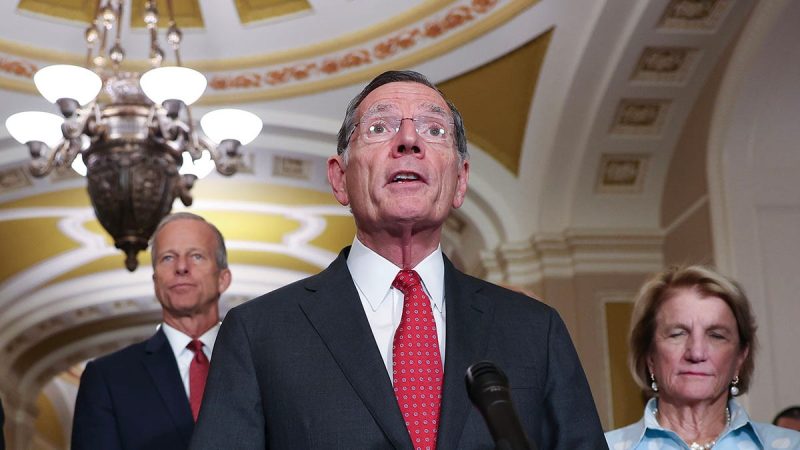
Senate Majority Whip John Barrasso is ready to go nuclear on Senate Democrats and their blockade of President Donald Trump’s nominees.
Before leaving Washington, D.C., to their respective home states, Senate Republicans were on the verge of a deal with their colleagues across the aisle to hammer out a deal to ram through dozens of Trump’s picks for non-controversial positions.
But those talks fell apart when Trump nuked any further negotiations over funding demands from Senate Minority Leader Chuck Schumer, D-N.Y. Currently, there are 145 pending nominations on the Senate’s executive calendar, with that number expected to balloon when the upper chamber reopens for business.
Lawmakers are set to return on Tuesday, and Barrasso, R-Wyo., wants to immediately tackle the nomination quandary. He’s engaged in a public pressure campaign, writing an op-ed for the Wall Street Journal directly calling out Schumer.
Meanwhile, he’s facilitated talks among Senate Republicans on the best path forward, and told Fox News Digital in an interview that, at this point, he’s willing to do anything necessary to see the president’s picks confirmed.
‘We need to either get a lot of cooperation from the Democrats, or we’re going to have to roll over them with changes of the rules that we’re going to be able to do in a unilateral way, as well as President Trump making recess appointments,’ he said.
Senate Democrats, under Schumer’s direction, are unlikely to play ball, however.
Schumer, in response to Barrasso’s public jab against him and Senate Democrats, contended in a statement that ‘historically bad nominees deserve a historic level of scrutiny by Senate Democrats.’
‘Anybody nominated by President Trump is, in Schumer’s words, ‘historically bad.’ Why? Because they were nominated by President Trump,’ Barrasso shot back. ‘That is his sole criteria for which these people are being gone after and filibustered, each and every one of them, even those that are coming out of committee, many, many of whom are with bipartisan support.’
Unilaterally changing the rules, or the nuclear option, would allow Republicans to make tweaks to the confirmation process without help from Democrats, but it could also kneecap further negotiations on key items that would require their support to advance beyond the Senate filibuster.
Barrasso was not worried about taking that route, however, and noted that the nominees that he and other Republicans were specifically considering would be ‘sub-Cabinet level positions’ and ambassadors.
Up for discussion are changes to the debate time, what kind of nominee could qualify for a speedier process and whether to give the president runway to make recess appointments, which would require the Senate to go into recess and allow Trump to make appointments on a temporary basis.
‘When you take a look at this right now, it takes a 30-minute roll-call vote to get on cloture, and then two hours of debate time, and then another 30-minute roll-call vote,’ Barrasso said. ‘Well, that’s three hours, and it’s time when you can’t do legislation, you can’t do any of the other things.’
But there is a menu of key items that Congress will have to deal with when they return, particularly the deadline to fund the government by Sept. 30.
Barrasso acknowledged that reality, and noted that it was because of the hefty schedule that he wanted a rules change to be put front and center.
‘There’s not going to be any time to — or there’s going to be limited time, I should say, to actually get people through the nominations process, which is just going to drag on further, and you’ll have more people having hearings and coming out of committees,’ he said.
‘This backlog is going to worsen this traffic jam at the Schumer toll booth. So, we are going to do something, because this cannot stand.’
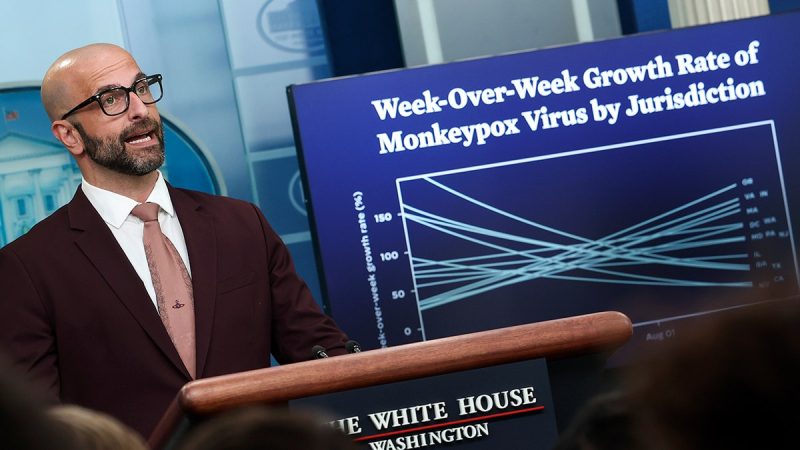
Demetre Daskalakis, an official at the Centers for Disease Control and Prevention (CDC), resigned this week, claiming the Trump administration’s policies ignore science. However, his own leadership during the Biden-era monkeypox response was criticized for putting optics over public health.
Amid the Trump administration’s efforts to push out CDC Director Susan Monarez, a handful of other top CDC officials, including Daskalakis, resigned in protest of the Trump administration’s policies. Daskalakis wrote in his resignation letter that was posted to social media that the health policies put forward by Secretary Robert F. Kennedy do not ‘reflect scientific reality.’ He also accused the Trump administration of attempting to ‘erase transgender populations,’ while also using the term ‘pregnant people’ to describe women who are about to give birth.
But flashback to 2022 and 2023, after the monkeypox virus had spread across several countries and made its way into the U.S., during which Daskalakis was among the Biden administration’s top advisers who spearheaded the national response to the disease outbreak.
Government communications from that time period, uncovered by watchdog group the Oversight Project, show that officials were aware that the disease was spreading among the gay community. However, those communications, and other records, show the administration appeared to be more concerned with protecting the stigma targeting the gay community, than they were with implementing measures that would provide the best mitigation response.
‘A common theme was public health officials identifying locations where outbreaks occurred, to include bathhouses and saunas,’ according to the Oversight Project. ‘Officials never broached consideration of shutting down these locations. This draws a stark contrast to the public health guidance and shutdowns of gathering places during COVID, to include gyms and skate parks.’
In 2023, after the monkeypox outbreak had taken hold in the U.S., Daskalakis went on national television to let the country know that his team was ‘making sure [they] got the word out in a way that supports people’s joy, as opposed to calling them risky.’
‘You know, one person’s idea of risk, is another person’s idea of a great festival or Friday night, for that matter. So, we have to sort of embrace that with joy and make sure that folks know how to keep themselves safe,’ the Biden monkeypox coordinator added.
Meanwhile, during the outbreak, Daskalkis posted a tweet from gay sex app Grindr that stated ‘Dr. Daskalakis could jab me any day,’ with a sticker of a flattered cat.
In other social media posts from around the same time, Daskalkis can be seen using male models wearing leather bondage straps to make an entrance at an HIV prevention summit.
While in his role at the White House leading the monkeypox response, Daskalkis also reportedly ran an STD screening operation from an after-hours sex club in New York City. When asked about the operation in an interview, Daskalakis described it as ‘exciting’ and added there was ‘not much sleep time.’ Later in the interview, he added: ‘I’d already kind of been the bathhouse HIV testing doctor.’
Fox News Digital reached out to Daskalakis about the juxtaposition between his criticism of Kennedy’s policies not reflecting ‘scientific reality,’ and his role in the Biden administration’s approach to monkeypox, but did not receive an immediate response.

The gold price was on the rise this week, breaking through US$3,400 per ounce once again.
It’s been pushed higher by US dollar weakness, as well as Federal Reserve turmoil.
President Donald Trump has been pressuring Fed Chair Jerome Powell to cut interest rates for months, and on Monday (August 25) the situation developed further when Trump posted a letter on his social media platform Truth Social. In it, he said he was removing Lisa Cook from her position on the central bank’s board of governors due to allegations of mortgage fraud.
Cook, who has been voting to hold rates steady, was due to serve until 2038; she has now filed a lawsuit asking for Trump’s order to be declared ‘unlawful and void.’
The move has spurred questions about whether Trump can actually fire her — while the Federal Reserve Act doesn’t allow him to remove Fed officials at will, he can do so ‘for cause.’
For its part, the Fed has said it will abide by any court decision.
The situation is still developing, and gold market watchers are keeping a close eye on how it plays out. The yellow metal tends to fare better when interest rates are low, and some experts believe that a rate cut from the Fed could kick off its next move higher
The Fed’s next meeting is scheduled to run from September 16 to 17. Expectations are high that it will cut rates at that time, even though the latest data shows that its preferred measure of inflation, the personal consumption expenditures (PCE) price index, was up 2.6 percent year-on-year in July.
Core PCE, which excludes food and energy, saw a rise of 2.9 percent.
The US Department of the Interior has released a new draft critical minerals list, and the recommended additions include silver, as well as potash, silicon, copper, rhenium and lead.
Silver’s potential inclusion is turning heads in the mining community as market participants assess the potential impact for the metal. The critical minerals list is designed to guide federal strategy, investment and permitting deals as the US works to lock down supply of key commodities, meaning that silver-focused companies could see benefits such as tax breaks and faster timelines.
In total, the draft list has 54 minerals, with 50 included based on results from an economic effects assessment. Three were selected on the back of a qualitative evaluation, and zirconium is there because of the potential for a single point of failure in the US supply chain.
The list was set up after a 2017 executive order from Trump and is updated every three years.
It’s worth noting that silver and the other recommended additions aren’t officially critical minerals yet — the draft critical minerals list was posted for public comment on Tuesday (August 26), and feedback will be accepted for 30 days. It’s also worth noting that two commodities may be stripped of their critical mineral status — arsenic and tellurium have been recommended for removal.
Critical minerals lists vary from country to country based on individual needs, although in many cases they have similarities. In January 2024, a group of silver industry participants, including many major miners, sent a letter to Canada’s energy and natural resources minister proposing that silver be included in the nation’s critical minerals list; to date, it has not been added.
Sweden’s government has proposed the removal of the country’s ban on uranium mining as it looks to reduce its reliance on imports of the energy fuel.
Uranium mining has been banned in Sweden since 2018, but the country has six operating reactors and generates around one-third of its power from nuclear energy.
The ban is set to be removed on January 1, 2026, and comes as nations increasingly look to nuclear power to fill their energy needs. It also comes amid supply questions — although demand is rising and prices are out of a years-long slump, miners have been slow to ramp back up post-Fukushima.
Just last week, Kazatomprom said it was lowering its 2026 production target compared to earlier estimates, cutting about 8 million pounds. Although the company sees stability in long-term uranium prices and strong sector fundamentals, it isn’t prepared to return to 100 percent levels.
Cameco (TSX:CCO,NYSE:CCJ) made a similar statement this week, saying its 2025 output will be impacted by delays in transitioning the Saskatchewan-based McArthur River mine to new mining areas. Production will be 4 million to 5 million pounds lower, although there is a chance for Cigar Lake to partially offset that loss.
Securities Disclosure: I, Charlotte McLeod, hold no direct investment interest in any company mentioned in this article.

Statistics Canada released its second-quarter gross domestic product (GDP) figures on Friday (August 29). The data showed that the Canadian economy shrank 0.4 percent in the second quarter and declined 1.6 percent on an annualized basis. The decrease comes following first-quarter gains of 0.5 percent and a 2 percent annualized increase.
Much of the decrease was attributed to a 7.5 percent drop in exports compared to Q1. Canadian exports had risen 1.4 percent in the first three months of the year as US companies increased imports to get ahead of incoming tariffs.Excluding the lower costs at the pumps, CPI remained steady at 2.5 percent, the same increase as May and June.
On an industry level, new monthly data for June shows that the resource sector grew by 0.1 percent after two months of declines, primarily driven by a 2.6 percent gain in the oil and gas subsector, with oil sands extraction rising 6.4 percent over May. However, gains were offset by a 9.7 percent monthly decline in support activities for the resource sector, its largest drop in five years, led by reduced rigging and drilling activities.
South of the border, the US Bureau of Economic Analysis released its second estimate for Q2 real GDP on Thursday (August 28). The data shows that US GDP grew by 3.3 percent during the quarter, 0.3 percent higher than its advance estimate.
According to the agency, the figure reflects a decrease in imports and an increase in consumer spending. The GDP’s upward momentum was tempered by a 13.8 percent decrease in private domestic investment, marking the most significant decline since 2020, during the pandemic.
The growth follows a 0.5 percent decrease in the first quarter of 2025, which saw a significant rise in imports.
This week also saw US President Donald Trump attempt to remove US Federal Reserve Board of Governors member Lisa Cook. Trump justified the decision based on Federal Housing Finance Agency Director Bill Pulte’s claim that Cook claimed primary residence in two mortgage applications submitted weeks apart in 2021. She was confirmed to the Fed Board of Governors in May 2022.
Cook is fighting the move in court, with her lawyer stating that Trump’s unsubstantiated allegation of an event prior to Cook’s confirmation does not meet the ’cause’ required by the Federal Reserve Act to remove a governor. By the end of the day on Friday, the judge hearing the case did not reach a decision on whether to issue a temporary restraining order that would allow Cook to remain in her role during the case.
Pulte has previously made similar allegations against other prominent Democrats, including California Senator Adam Schiff, a vocal critic of Trump, and New York Attorney General Letitia James, who oversaw a civil suit against Trump that resulted in a US$500 million award.
Trump has been eager to reshape the Federal Reserve Board and has hinted that he would like to replace Chairman Jerome Powell before his term ends in 2026. Trump believes the Fed has not been acting quickly enough to lower interest rates and stimulate the economy.
Canadian equity markets were largely unfazed by Canada’s weak GDP data. In fact, the S&P/TSX Composite Index (INDEXTSI:OSPTX) set a new record on Friday, closing the week up 1.73 percent to 28,564.45. The S&P/TSX Venture Composite Index (INDEXTSI:JX) did even better, climbing 5.36 percent to finish Friday at 829.57. The CSE Composite Index (CSE:CSECOMP) fell 0.45 percent on Friday following the StatsCan release, but gained 4.17 percent overall during the week to 166.9.
US equity markets also posted gains this week, but fell from record highs on Friday following a selloff of tech stocks. The S&P 500 (INDEXSP:INX) was up 1.19 percent to 6,460.25, while the Nasdaq 100 (INDEXNASDAQ:NDX) rose 0.99 percent to 23,415.42. Meanwhile, the Dow Jones Industrial Average (INDEXDJX:.DJI) gained 1.32 percent on the week to 45,631.73.
The gold price gained 3.19 percent this week on expectations of a September rate cut by the Federal Reserve, reaching US$3,448.15 per ounce by 4:00 p.m. EDT on Friday. Silver ended the week with a larger gain of 4.2 percent, nearly crossing the US$40 per ounce mark in morning trading before settling at US$39.74 per ounce.
Copper also saw some upward movement, gaining 1.1 percent to US$4.59 per pound. The S&P GSCI (INDEXSP:SPGSCI) commodities index posted an increase of 1.3 percent by close on Friday, finishing at 549.70.
How did mining stocks perform against this backdrop?
Take a look at this week’s five best-performing Canadian mining stocks below.
Stocks data for this article was retrieved at 4:00 p.m. EDT on Friday using TradingView’s stock screener. Only companies trading on the TSX, TSXV and CSE with market caps greater than C$10 million are included. Mineral companies within the non-energy minerals, energy minerals, process industry and producer manufacturing sectors were considered.
Weekly gain: 117.24 percent
Market cap: C$23.77 million
Share price: C$0.63
Trifecta Gold is a gold exploration company focused on a portfolio of 11 properties in the Tombstone gold belt in the Yukon, Canada.
Its most advanced is its flagship Mt. Hinton gold-silver project, located near Hecla Mining’s (NYSE:HL) Keno Hill silver mine. The company’s project page indicates that vein float samples collected in January 2023 show grades of up to 273 grams per metric ton (g/t) gold.
The company has also been advancing exploration work at its Rye property, which hosts a gold-bismuth soil anomaly, as well as several gold-rich veins.
Shares in Trifecta rose this week alongside news on Thursday that the company had commenced its inaugural drill program at Rye, completing 970 meters across three holes. The announcement reported that the first hole intersected a high density of sheeted quartz veins.
The company said preliminary rock samples collected from the site earlier in 2025 returned multiple assays with greater than 5 g/t gold, including one highlight with 21.1 g/t gold and 8,550 parts per million (ppm) bismuth.
Weekly gain: 100 percent
Market cap: C$13.98 million
Share price: C$0.04
Consolidated Lithium is an exploration and development company working to advance a portfolio of hard rock lithium projects in Quebéc, Canada.
Its most advanced asset is the Vallée lithium project, a 75/25 joint venture between Consolidated and Sayona Mining (ASX:SAY,OTCQB:SYAXF). The project is located in the Abitibi Greenstone Belt adjacent to and along strike of Sayona’s and Piedmont Lithium (NASDAQ:PLL) North American Lithium mining operation. According to the company’s project page, the Vallée property hosts multiple lithium-bearing pegmatites over a 1 kilometer strike length.
Consolidated announced on Wednesday (August 27) that it signed a letter of intent with the Government of Quebéc-owned Soquem to earn an 80 percent interest in the Kwyjibo rare earth project, located in the Côte-Nord region of the province.
Under the terms of the letter, Consolidated can earn up to an 80 percent interest in the project through two phases, in return for a combination of cash payments, shares in Consolidated and project investments.
A 2017 preliminary economic assessment for Kwyjibo reports project economics including an after-tax net present value of C$373.9 million and an internal rate of return of 17.8 percent, with a payback period of 3.6 years.
Weekly gain: 68.75 percent
Market cap: C$44.34 million
Share price: C$0.27
Electric Metals is a mineral development company focused on advancing its flagship North Star manganese project in Minnesota, US. According to the company, the asset is North America’s highest-grade manganese resource. It plans to produce high-purity manganese sulphate monohydrate for lithium-ion batteries.
The most recent news from Electric Metals was released on Tuesday, when it announced a preliminary economic assessment for the project. The assessment demonstrated a base-case after-tax net present value of US$1.39 billion, with an internal rate of return of 43.5 percent and a payback period of 23 months. and suggested an average annual after-tax cash flow of US$249.6 million.
The report also included an updated mineral resource estimate with an indicated resource of 7.6 million metric tons of ore grading 19.07 percent manganese, 22.33 percent iron and 30.94 percent silicon, and an inferred resource of 3.73 million metric tons of ore grading 17.04 percent manganese, 19.04 percent iron and 30.03 percent silicon.
Weekly gain: 58.33 percent
Market cap: C$31.93 million
Share price: C$0.38
Sage Potash is a potash exploration company currently working to advance its portfolio of mineral holdings in Utah’s Paradox Basin in the US.
Historic oil and gas exploration in the basin dating back a century discovered the potential for the potash beds, but they were too deep for mining methods at the time. Sage has since confirmed their presence through its own exploration.
In a revised technical report from February 2023, the company reported an inferred mineral resource estimate of up to 159.3 million metric tons of in-place sylvinite from the upper potash bed and up to 120.2 million metric tons of sylvinite from the lower potash bed.
On August 14, Sage announced that Stockwell Day had joined the company board. Day served several ministerial roles for the Canadian government under Prime Minister Stephen Harper, including as President of the Treasury Board and Minister of International Trade.
This was followed by news on Wednesday that Day had been granted 600,000 stock options at an exercise price of C$0.30 per share and would remain valid for a period of five years.
Sage’s share price spiked earlier this week after the US Government added potash in its draft of an updated list of critical minerals.
Weekly gain: 58.33 percent
Market cap: C$24.8 million
Share price: C$0.095
Kincora Copper is an exploration company operating under a project generator model and partnering with other companies to advance its portfolio, including copper-gold projects in the Macquarie Arc of New South Wales, Australia.
Among them is the Northern Junee-Narromine Belt (NJNB) land package, which is covered by a May 2024 earn-in agreement that could see AngloGold Ashanti (NYSE:AU,JSE:ANG) earn up to an 80 percent interest in the Nyngan and Nevertire licenses through AU$50 million in exploration expenditures or AU$25 million for exploration and the completion of a pre-feasibility study.
Kincora secured a second agreement with AngloGold Ashanti in April for the Nyngan South, Nevertire South and Mulla licenses with similar terms, bringing the total exploration funding to AU$100 million.
On Monday (August 25), Kincora announced results from the first drilling program at the Nyngan project, noting that assays support the potential for porphyry copper and epithermal gold, and that it saw ‘encouraging results at particularly shallow depths’ from drill targets identified by a ground gravity survey earlier this year.
Additionally, Kincora said that drilling is ongoing at the Nevertire South and Nevertire projects, with the initial program planned for seven holes and 2,150 meters.
The TSX, or Toronto Stock Exchange, is used by senior companies with larger market caps, and the TSXV, or TSX Venture Exchange, is used by smaller-cap companies. Companies listed on the TSXV can graduate to the senior exchange.
As of May 2025, there were 1,565 companies listed on the TSXV, 910 of which were mining companies. Comparatively, the TSX was home to 1,899 companies, with 181 of those being mining companies.
Together, the TSX and TSXV host around 40 percent of the world’s public mining companies.
There are a variety of different fees that companies must pay to list on the TSXV, and according to the exchange, they can vary based on the transaction’s nature and complexity. The listing fee alone will most likely cost between C$10,000 to C$70,000. Accounting and auditing fees could rack up between C$25,000 and C$100,000, while legal fees are expected to be over C$75,000 and an underwriters’ commission may hit up to 12 percent.
The exchange lists a handful of other fees and expenses companies can expect, including but not limited to security commission and transfer agency fees, investor relations costs and director and officer liability insurance.
These are all just for the initial listing, of course. There are ongoing expenses once companies are trading, such as sustaining fees and additional listing fees, plus the costs associated with filing regular reports.
Investors can trade on the TSXV the way they would trade stocks on any exchange. This means they can use a stock broker or an individual investment account to buy and sell shares of TSXV-listed companies during the exchange’s trading hours.
Article by Dean Belder; FAQs by Lauren Kelly.
Securities Disclosure: I, Dean Belder, hold no direct investment interest in any company mentioned in this article.
Securities Disclosure: I, Lauren Kelly, hold no direct investment interest in any company mentioned in this article.